Brain Stimulation May Greatly Reduce Hard-To-Treat Seizures
Source: Neuromodulation : journal of the International Neuromodulation Society
Summary
What was studied
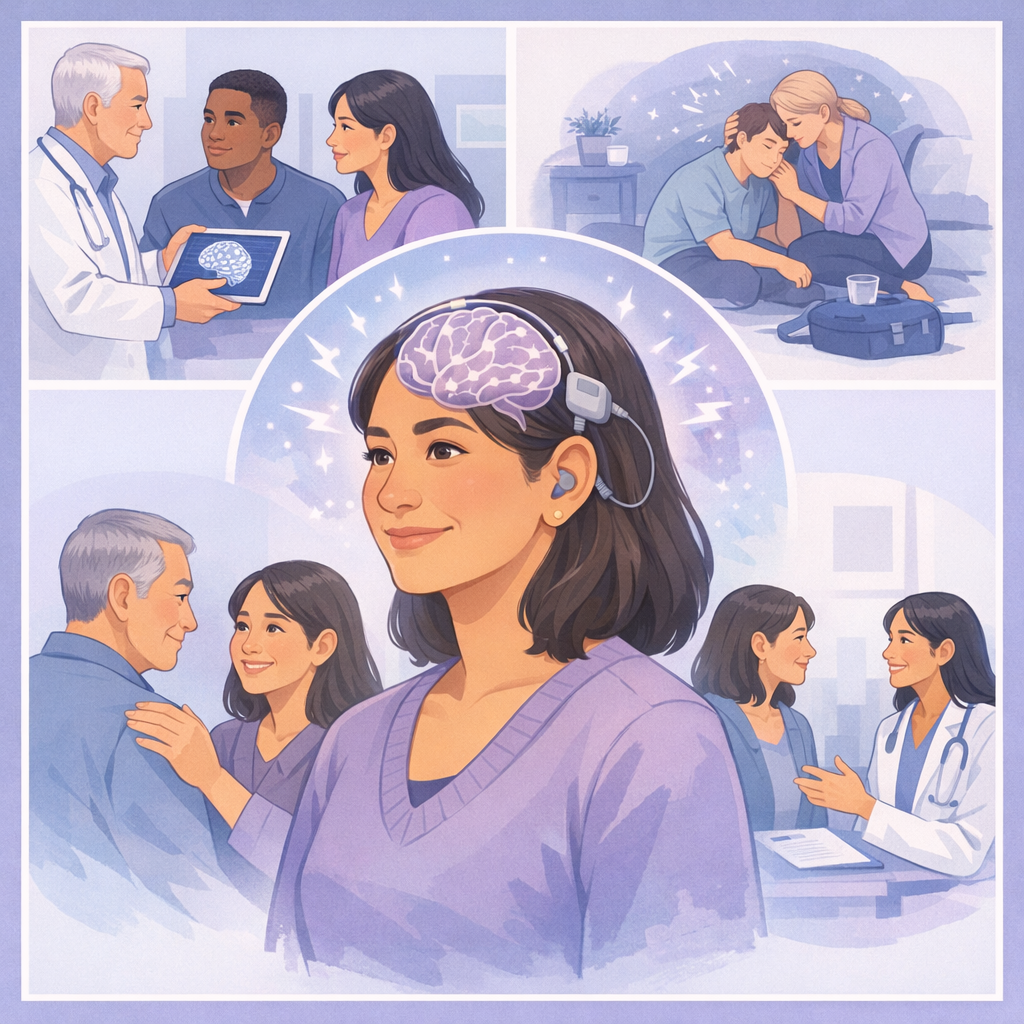
This paper was a systematic review, which means the authors searched the medical literature and combined results from earlier reports. They looked at chronic subthreshold cortical stimulation (CSCS) for people with drug-resistant epilepsy in the paracentral region, an area near the brain's movement cortex where standard epilepsy surgery may be too risky.
The review included 6 published studies with 17 total patients. These reports were case reports, case series, and observational studies in humans. The authors looked at seizure outcomes, safety, stimulation settings, quality of life, and any changes in neurologic function over an average follow-up of about 31 months.
What they found
Across the 17 patients, 8 out of 17 (47%) became seizure-free, and 6 more (35%) had at least a 90% drop in seizures. Patients whose epilepsy had a visible brain lesion on imaging had higher seizure-free rates than patients without a visible lesion. No major surgery-related or stimulation-related adverse events were reported in the included studies. Stimulation settings differed a lot between patients, and both continuous and cycling stimulation were reported as effective. Some reports also described better motor function, mood, thinking, and quality of life.
Limits of the evidence
The evidence is early and based on only 17 patients from 6 small published reports. There were no randomized trials, and the authors noted possible publication bias, meaning successful cases may be more likely to appear in the literature. The stimulation methods varied widely, so it is hard to know which settings work best. Because this was a review of small studies, it cannot establish that CSCS is better than other treatments or guarantee the same results for future patients.
For families and caregivers
For families dealing with seizures coming from the paracentral region, this review suggests CSCS may be a promising option when medicines have not worked and surgery is hard to do safely. The reported seizure results were encouraging in this small group, and major harms were not reported.
Still, the evidence is limited, so families should see this as an early but hopeful area rather than a proven standard treatment. It may be most relevant in specialized epilepsy centers that can evaluate whether a child's or adult's seizure focus and brain imaging fit this approach.
What to watch next
Stronger evidence would come from larger prospective controlled studies that compare CSCS with other treatment options and identify which patients benefit most.
Terms in this summary
- drug-resistant epilepsy
- Epilepsy that does not come under good control after trying appropriate seizure medicines.
- paracentral region
- A part of the brain near areas that control movement and sensation, especially for the legs and nearby body parts.
- eloquent cortex
- Brain tissue that controls important functions like movement, speech, or sensation, where surgery can cause major problems.
- neurostimulation
- Treatment that uses electrical signals to affect brain or nerve activity.
- chronic subthreshold cortical stimulation
- A treatment that gives ongoing electrical stimulation to the brain surface at a level below what would directly trigger movement or other obvious effects.
- lesional epilepsy
- Epilepsy linked to a visible abnormal area on brain imaging, such as an injury or scar.
- observational study
- A study where researchers observe what happens with a treatment but do not randomly assign people to different groups.
- publication bias
- A problem where studies with positive results are more likely to be published than studies with negative or unclear results.
Free: Seizure First Aid Quick Guide (PDF)
Plus one plain-language weekly digest of new epilepsy research.
Unsubscribe anytime. No medical advice.