AI Tools Show Promise For Detecting Childhood Seizures
⚠️ Infant dosing/safety: medication and diet decisions for infants require individualized medical guidance.
Source: Neurology and therapy
Summary
What was studied
This paper was a systematic review, which means the authors searched past studies rather than testing one new AI tool themselves. They looked across three databases for studies in any language about artificial intelligence and machine learning tools used to interpret clinical data.
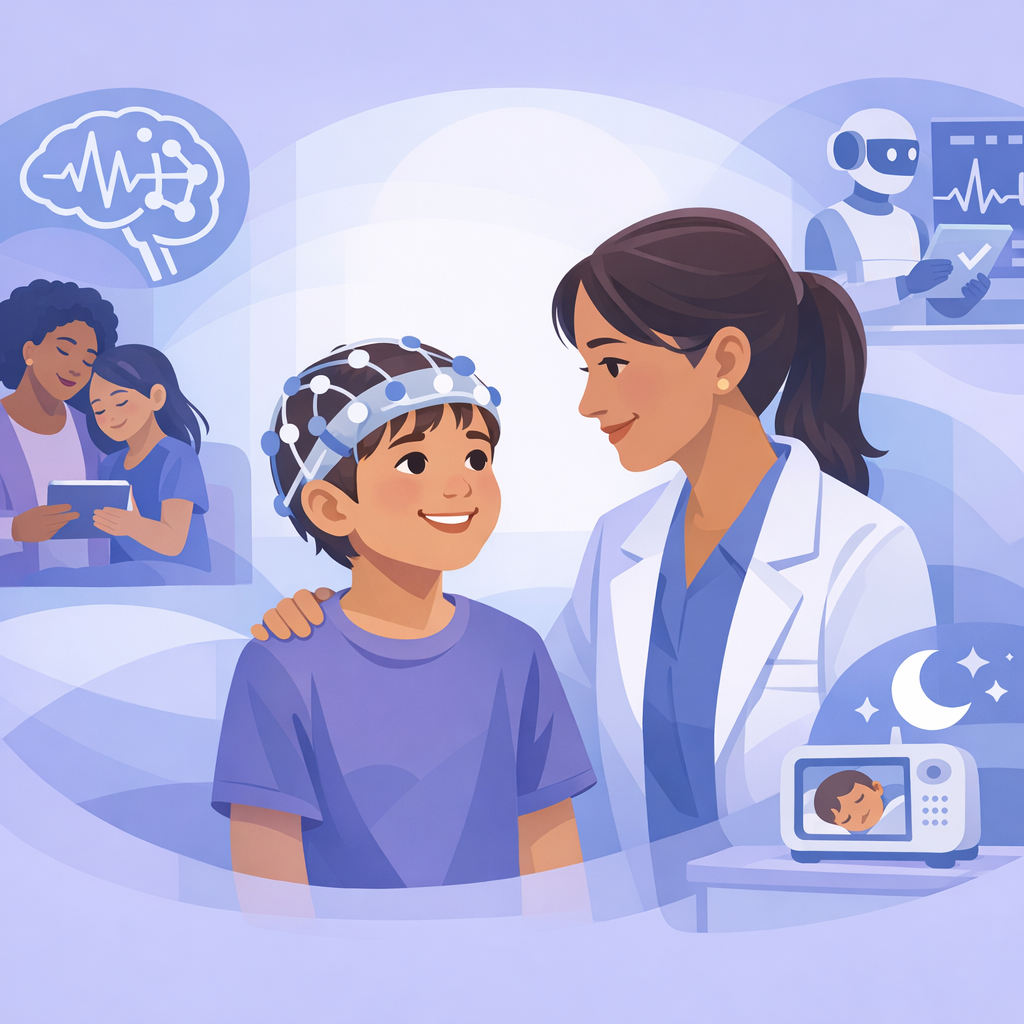
The review focused especially on EEG-related applications. The authors compared different kinds of models, looked at which ones seemed to perform best, and summarized where these tools have been used, such as seizure detection, syndrome recognition, sleep-related EEG problems like ESES, neonatal monitoring, continuous EEG surveillance, and wearable devices.
What they found
The review found that convolutional neural networks were the most common deep learning method, and support vector machines were the most common traditional machine learning method. AI-driven seizure detection showed performance approaching that of experienced specialists. Reported applications also included identifying specific epilepsy syndromes, detecting ESES and spike-wave index, supporting continuous EEG surveillance, neonatal monitoring, and wearable seizure detection.
In some reports, AI models had over 90% accuracy when separating normal EEGs from abnormal EEGs. Automated seizure detection was the most widespread case of clinical use.
Limits of the evidence
This review summarizes earlier studies, so its conclusions depend on the quality of those studies. The abstract says many studies had small groups, typically fewer than 100 patients, which limits confidence in how reliable the results are across broader settings.
The abstract concludes that future work should focus on large-scale, multicenter validation before clinical implementation. It also does not provide detailed numbers for each application, so it is hard to compare how strong the evidence is across all use cases.
For families and caregivers
For families, this review suggests that AI tools may become helpful assistants for reading EEGs, spotting seizures, and supporting monitoring. The results are encouraging, especially for seizure detection and identifying abnormal versus normal EEGs.
But these tools are still limited by the small size of many studies. Families can see this as progress, while recognizing that larger studies across multiple centers are still needed before wider clinical implementation.
What to watch next
Stronger evidence would come from large-scale, multicenter validation studies that test AI tools across different hospitals and patient groups.
Terms in this summary
- artificial intelligence (AI)
- Computer systems designed to find patterns or make predictions from data.
- machine learning
- A type of AI that learns from examples and data instead of following only fixed rules.
- EEG
- A test that records the brain's electrical activity using sensors on the scalp.
- convolutional neural network
- A kind of AI model often used to recognize complex patterns in data such as signals or images.
- support vector machine
- A traditional machine learning method used to sort data into groups, such as normal versus abnormal.
- ESES
- Electrical status epilepticus during sleep, an EEG pattern with frequent abnormal discharges during sleep.
- spike-wave index
- A measure of how much of sleep EEG shows spike-wave activity.
- multicenter validation
- Testing a tool in several hospitals or centers to see if it works reliably in different settings.
Free: Seizure First Aid Quick Guide (PDF)
Plus one plain-language weekly digest of new epilepsy research.
Unsubscribe anytime. No medical advice.