Brain Stimulation Types May Help Different Symptoms
Source: Clinical psychopharmacology and neuroscience : the official scientific journal of the Korean College of Neuropsychopharmacology
Summary
What was studied
This paper was a systematic review that looked at studies directly comparing two noninvasive brain stimulation methods: transcranial alternating current stimulation (tACS) and transcranial direct current stimulation (tDCS). The review followed PRISMA methods and searched major databases and trial registries. Out of 955 records, 11 head-to-head studies were included.
The included studies involved people with several psychiatric and neurological conditions: schizophrenia, depression, mild cognitive impairment, ataxia, tinnitus, and epilepsy. There were 4 studies in schizophrenia, 2 each in tinnitus and epilepsy, and 1 each in depression, mild cognitive impairment, and ataxia. Treatment plans varied a lot, with 1 to 10 sessions, usually 20 minutes long, using 1 to 2 mA. The tACS frequency also differed across studies, from delta to high gamma, depending on the symptom being targeted.
What they found
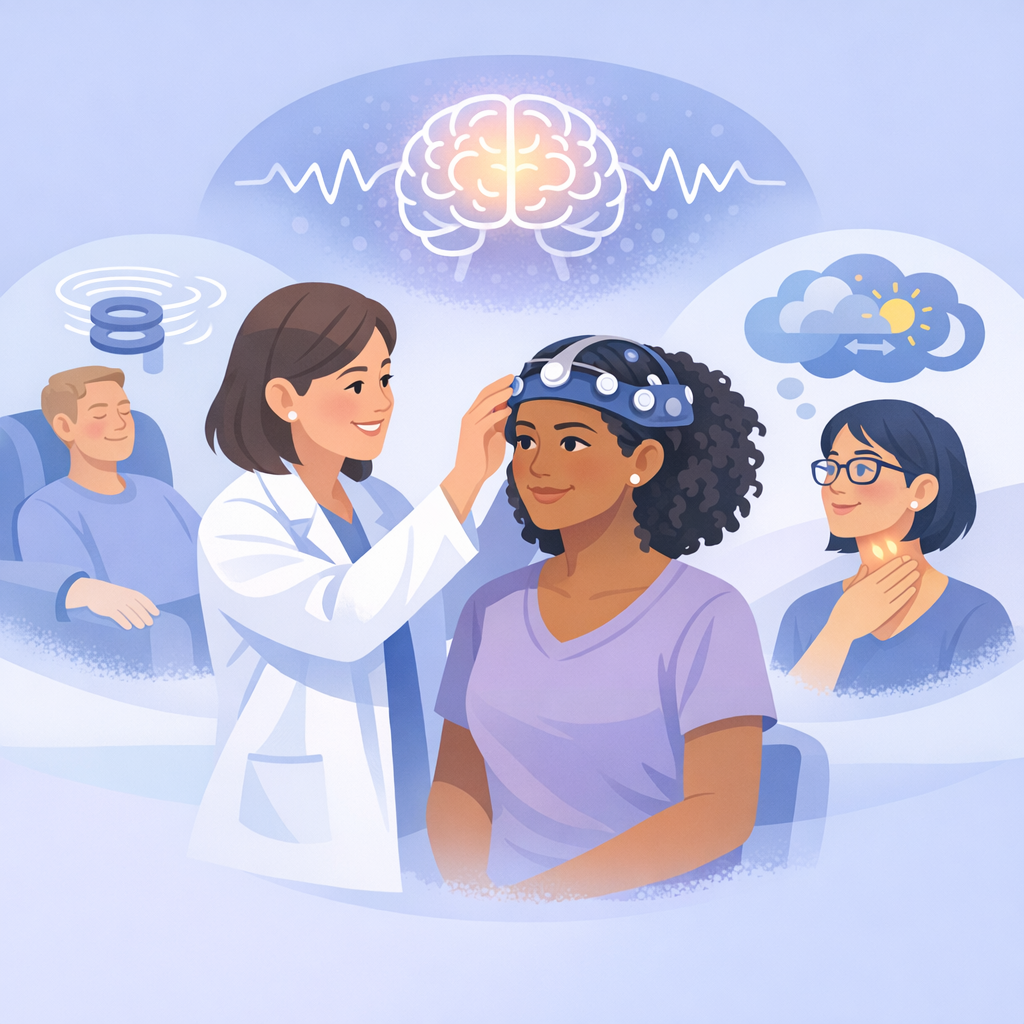
Overall, both tACS and tDCS were described as safe and promising, but their apparent effectiveness varied by disorder and stimulation settings. In psychiatric disorders, alpha-tACS was associated with improvement in auditory hallucinations, while tDCS was associated with relatively greater cognitive benefits. A delta high-definition tACS approach was linked to improvements in cognitive deficits and general psychopathology, and theta-tACS fared better in depression.
In neurological disorders, gamma-tACS was associated with improvement in mild cognitive impairment and epilepsy. By contrast, bifrontal tDCS was associated with improvement in tinnitus, and cerebellar tDCS significantly outperformed gamma-tACS in neurodegenerative ataxia. The review suggests that details such as electrode placement and stimulation frequency may influence results.
Limits of the evidence
The evidence is still limited. Only 11 studies were included, and they covered many different disorders, treatment setups, and outcomes, so the results are hard to combine into one clear answer. Many studies had some or major risk of bias, which means the findings may be less reliable.
The review also notes that many protocols, especially in neurological disorders, used single-session protocols. Because of this, the review cannot determine which method is superior overall or guide clinical use with confidence. For epilepsy specifically, the abstract says gamma-tACS was associated with improvement, but it does not give details about seizure outcomes, number of participants, or long-term safety.
For families and caregivers
For families, this review shows that noninvasive brain stimulation is being studied as a possible treatment tool for brain and mental health conditions, including epilepsy. It also suggests that these methods are not interchangeable: one type may appear to work better than the other depending on the condition and exactly how it is delivered.
At the same time, this is not strong enough evidence to show that one method should be routinely chosen over the other in epilepsy or other disorders. Larger and better-designed studies are still needed before these approaches can be used with confidence in regular care.
What to watch next
Larger, rigorously designed studies are needed to directly compare tACS and tDCS in epilepsy and confirm whether one appears more effective than the other.
Terms in this summary
- systematic review
- A study that collects and summarizes results from many earlier studies using a planned method.
- tACS
- Transcranial alternating current stimulation, a treatment that sends a weak electrical current that changes back and forth through the scalp.
- tDCS
- Transcranial direct current stimulation, a treatment that sends a weak steady electrical current through the scalp.
- noninvasive
- A treatment that does not require surgery or going inside the body.
- neuromodulation
- A way of changing brain activity using electrical or other forms of stimulation.
- risk of bias
- The chance that study design or conduct may have affected the results in a misleading way.
- montage
- The pattern of where electrodes are placed on the head.
- mild cognitive impairment
- A condition with noticeable problems in memory or thinking that are greater than normal aging but not as severe as dementia.
Free: Seizure First Aid Quick Guide (PDF)
Plus one plain-language weekly digest of new epilepsy research.
Unsubscribe anytime. No medical advice.