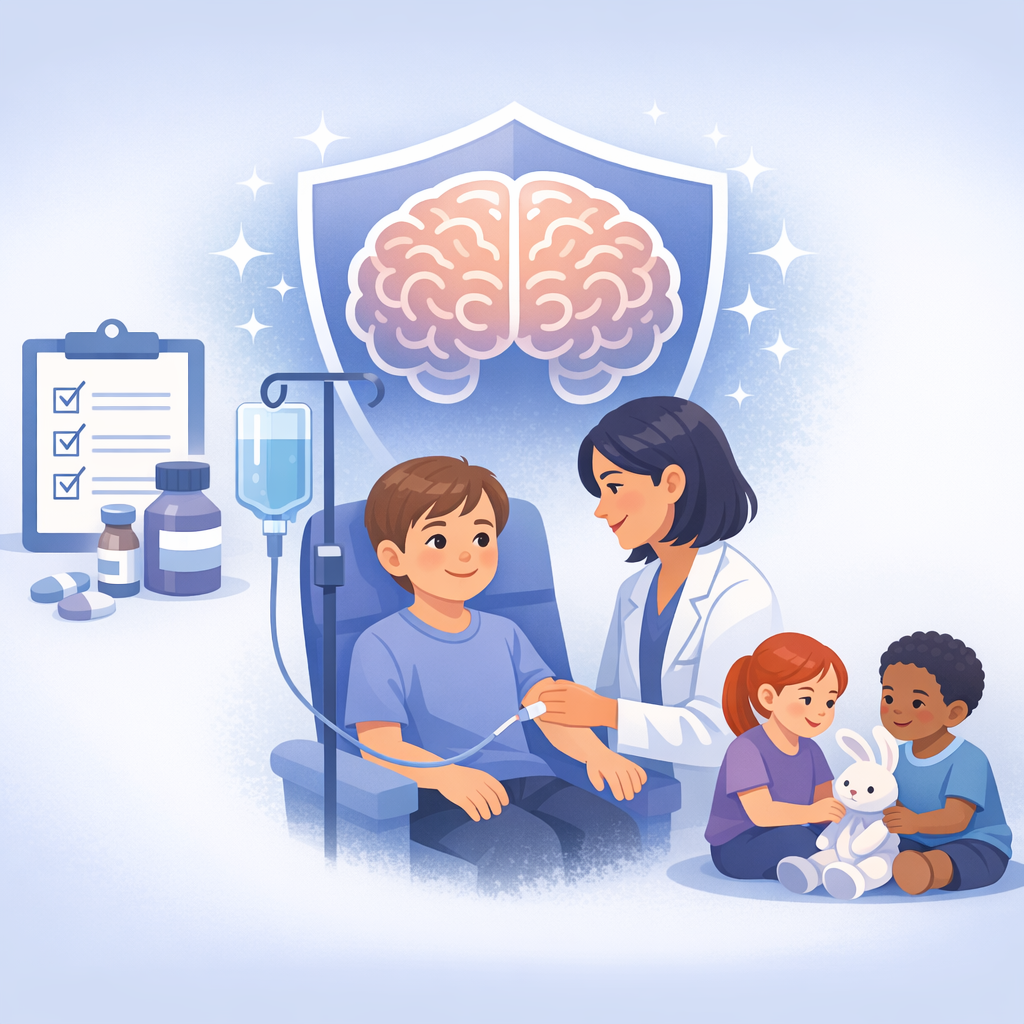
IVIG May Reduce Seizures In Some Children
Source: Frontiers in neurology
Summary
What was studied
This study looked at whether intravenous immunoglobulin, called IVIG, might help children with drug-resistant epilepsy. The researchers reviewed past medical records from one tertiary epilepsy center using a database of pediatric epilepsy patients.
They included 60 children ages 2 to 18 who had refractory seizures, regular follow-up, and IVIG treatment for at least 1 year. Children with autoimmune encephalitis were not included. The group had focal seizures, generalized seizures, or both. The researchers compared seizure frequency before IVIG, about 3 months after starting it, and 1 year later.
What they found
Overall, 36.7% of the children had at least a 50% reduction in seizure frequency within 1 year of IVIG use. Of those 22 children, 36.4% achieved seizure freedom. A statistically significant reduction in seizures in individual patients was observed only in children with generalized seizures. The authors reported that these findings could not be explained by changes in other antiseizure medicines.
Limits of the evidence
This was a retrospective chart review, so it looked back at records rather than testing IVIG in a planned trial. There was no comparison group, so the study cannot show from the abstract alone that IVIG caused the seizure improvement. The study was done at a single center and included 60 children, which may limit how widely the results apply. The abstract does not provide full details on adverse effects or which children were most likely to respond.
For families and caregivers
For families of children with drug-resistant epilepsy, this study suggests that long-term IVIG may help some children with refractory seizures. In this study, a statistically significant reduction in seizures was observed only in children with generalized seizures. Because this was a retrospective single-center study without a comparison group, stronger studies are still needed.
What to watch next
Studies with comparison groups could help clarify how effective IVIG is, which children may benefit most, and how safe it is over time.
Terms in this summary
- drug-resistant epilepsy
- Epilepsy in which seizures continue despite trying appropriate seizure medicines.
- intravenous immunoglobulin (IVIG)
- A treatment made from antibodies from donated blood plasma, given through a vein.
- retrospective study
- A study that looks back at existing medical records instead of following patients forward in time.
- tertiary epilepsy center
- A specialized hospital center that treats complex epilepsy cases.
- generalized seizures
- Seizures that involve both sides of the brain from the start.
- focal seizures
- Seizures that start in one area of the brain.
- autoimmune encephalitis
- Brain inflammation caused by the immune system attacking the brain.
- antiseizure medications
- Medicines used to prevent or reduce seizures.
Free: Seizure First Aid Quick Guide (PDF)
Plus one plain-language weekly digest of new epilepsy research.
Unsubscribe anytime. No medical advice.