EEG Findings Can Guide Epilepsy Surgery Talks By Age
Source: Clinical neurology and neurosurgery
Summary
What was studied
This study looked at how well scalp EEG findings matched the part of the brain that was later removed in epilepsy surgery. It included 594 people with focal epilepsy who achieved Engel class I outcomes after surgery: 454 adults and 140 children.
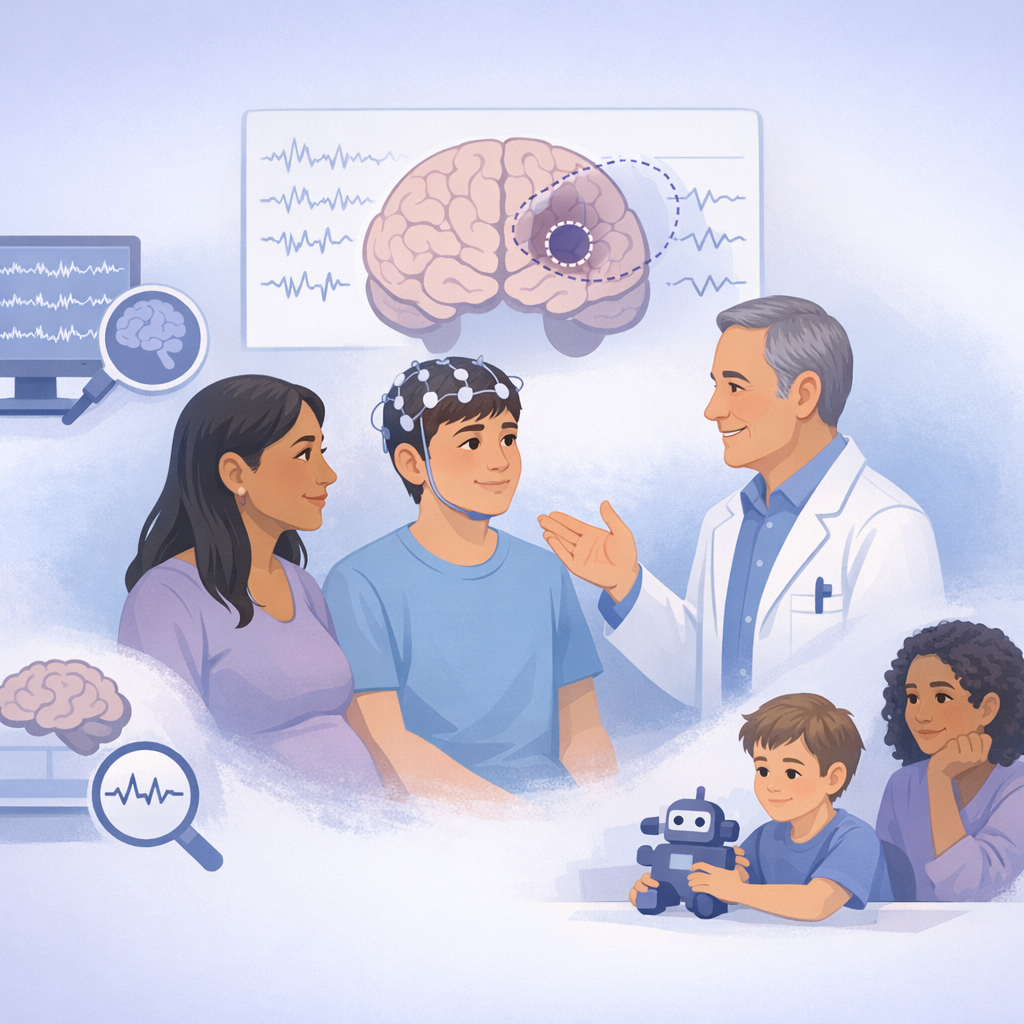
The researchers reviewed EEG recordings done before surgery and brain imaging done after surgery. They compared children and adults, and they also looked for factors linked with EEG results that matched the surgical area.
What they found
The match between scalp EEG and the surgical area differed in children and adults. In frontal lobe epilepsy, children were more likely than adults to have interictal EEG findings that matched the area removed. But among patients with recorded seizures, adults were more likely than children to have ictal EEG findings that matched, especially in temporal lobe epilepsy.
In children, interictal EEG concordance was associated with age at seizure onset and temporal lobe epilepsy. It was less likely in children with focal to bilateral tonic-clonic seizures or vascular malformations on MRI. In adults, temporal lobe epilepsy was the only predictor of concordant interictal EEG, while female sex was a negative predictor.
For ictal EEG, concordant interictal EEG predicted concordant ictal EEG in both age groups. In adults, age at seizure onset also predicted concordant ictal EEG, while tumor on MRI was a negative predictor.
Limits of the evidence
This was a retrospective study, so it looked back at existing records rather than testing a plan in real time. That means it can show associations but cannot establish cause and effect.
The study only included people who had surgery and achieved Engel class I outcomes. Because of that, the results may not apply to people who did not have this level of postoperative outcome or who were not surgical candidates. The abstract also does not give full details about how some predictors were measured or the size of each effect.
For families and caregivers
For families thinking about epilepsy surgery, this study suggests that scalp EEG may not perform the same way in children and adults. In some situations, especially depending on whether epilepsy is in the frontal or temporal lobe, EEG may be more or less likely to point to the area causing seizures.
This may help set expectations during presurgical counseling. A less clear scalp EEG does not necessarily mean surgery will not help, but it may mean the team considers other test results alongside it. For more context, see the tests used during an epilepsy surgery evaluation. The findings support asking how age group, seizure type, MRI findings, and suspected seizure location may affect how doctors interpret scalp EEG before surgery.
What to watch next
Prospective studies that include a broader range of surgery outcomes could help clarify how these age-related EEG patterns apply in clinical decision-making and counseling.
Terms in this summary
- scalp EEG
- A test that records the brain’s electrical activity using sensors placed on the scalp.
- focal epilepsy
- Epilepsy in which seizures start in one specific area of the brain.
- interictal EEG
- EEG activity recorded between seizures.
- ictal EEG
- EEG activity recorded during a seizure.
- temporal lobe epilepsy
- Epilepsy in which seizures start in the temporal lobe, a part of the brain near the sides of the head.
- frontal lobe epilepsy
- Epilepsy in which seizures start in the frontal lobe, the front part of the brain.
- focal to bilateral tonic-clonic seizure
- A seizure that starts in one area of the brain and then spreads to both sides, causing stiffening and jerking movements.
- Engel class I
- A surgery outcome category used to describe the best postoperative seizure outcomes.
Free: Seizure First Aid Quick Guide (PDF)
Plus one plain-language weekly digest of new epilepsy research.
Unsubscribe anytime. No medical advice.