Caring For Medically Complex Children Can Harm Family Well-Being
Source: Healthcare (Basel, Switzerland)
Summary
What was studied
This paper was a scoping review, which means the authors gathered and mapped existing research rather than testing one treatment. They searched studies published from 2011 to 2023 in PubMed, CINAHL, and EMBASE. They included studies that looked at health-related quality of life or mental health in family members or caregivers of children with medical complexity.
In total, 67 studies were included. These studies covered children with a range of serious or complex conditions, including epilepsy, congenital heart disease, cerebral palsy, technology dependence, and cancer. The studies used different designs, such as cross-sectional, cohort, case-control, pre-post, and qualitative studies. Caregivers were predominantly mothers.
What they found
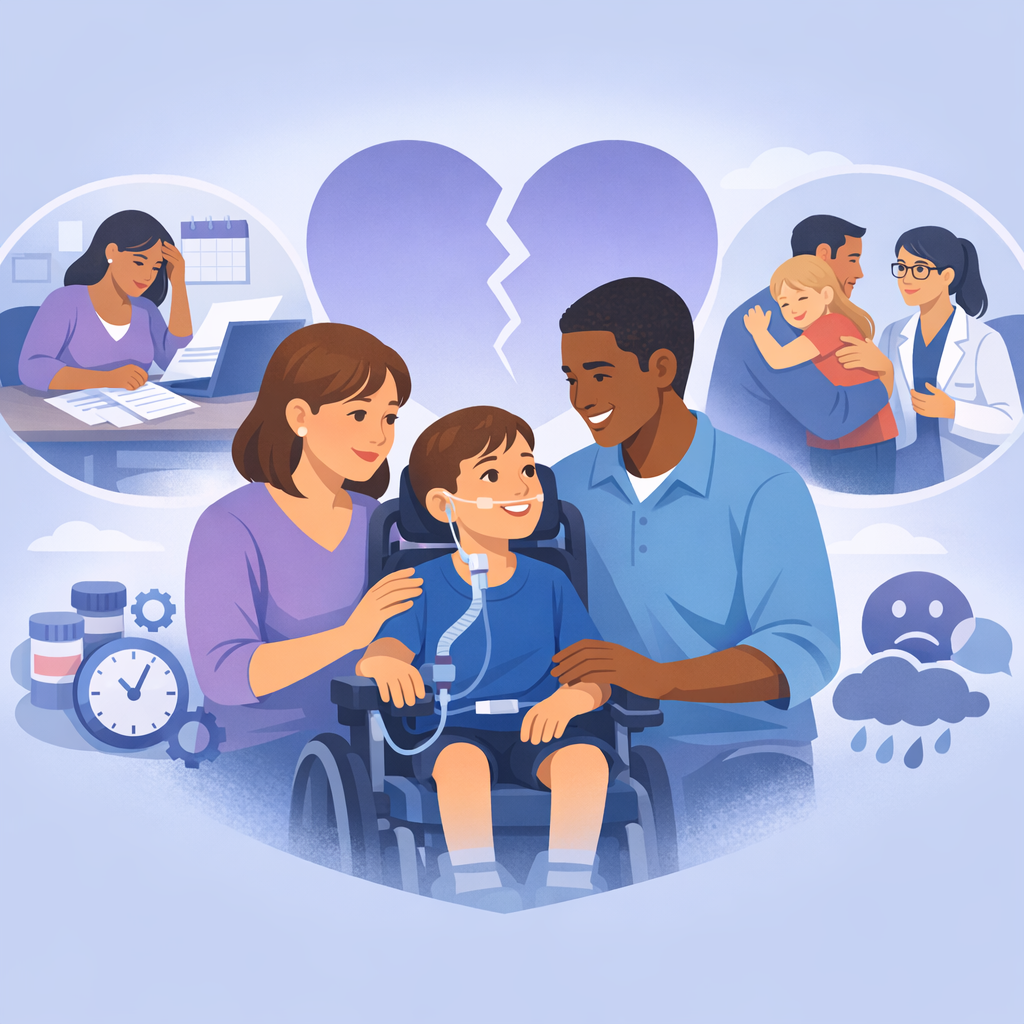
Across the studies, caregivers frequently reported poorer quality of life and higher levels of anxiety, depressive symptoms, or caregiving burden than comparison groups when comparison groups were available. The review identified six recurring themes: mothers often carried more of the caregiving burden; socio-economic factors and financing models were linked with family well-being; culture, religion, and spirituality were described as coping resources; family and social support were associated with less distress; school participation and coordinated services might reduce burden; and the child’s outcomes and the caregiver’s well-being appeared interdependent.
Limits of the evidence
Because this was a scoping review, it maps what has been studied but does not establish cause and effect. The included studies were very mixed in how they defined "children with medical complexity," what tools they used to measure quality of life or mental health, and what study designs they used, so results were hard to compare directly. Many studies focused mainly on mothers, so the findings may not fully reflect fathers, siblings, or other caregivers. The abstract also does not give detailed numbers for how large the differences were.
For families and caregivers
This review suggests that caring for a child with complex medical needs may affect the whole family, including caregiver stress, mood, and daily quality of life. It also suggests that family, social, school, and coordinated service supports may be relevant to family well-being. For families of children with epilepsy and other complex conditions, the study suggests that family well-being is an important part of care.
What to watch next
Future research should use more consistent definitions and measures and prospectively evaluate multicomponent interventions for caregiver mental health and family quality of life.
Terms in this summary
- scoping review
- A study that collects and summarizes existing research to show what is known and where gaps remain.
- health-related quality of life
- How a person’s health affects daily life, well-being, and ability to function.
- mental health
- Emotional and psychological well-being, including symptoms such as anxiety or depression.
- caregiver burden
- The stress and strain that can come with caring for someone with major health needs.
- cross-sectional study
- A study that looks at people at one point in time.
- cohort study
- A study that follows a group of people over time.
- qualitative study
- A study that uses interviews or observations to understand experiences in depth.
- technology dependence
- Needing medical equipment, such as feeding tubes or breathing support, to stay healthy.
Free: Seizure First Aid Quick Guide (PDF)
Plus one plain-language weekly digest of new epilepsy research.
Unsubscribe anytime. No medical advice.