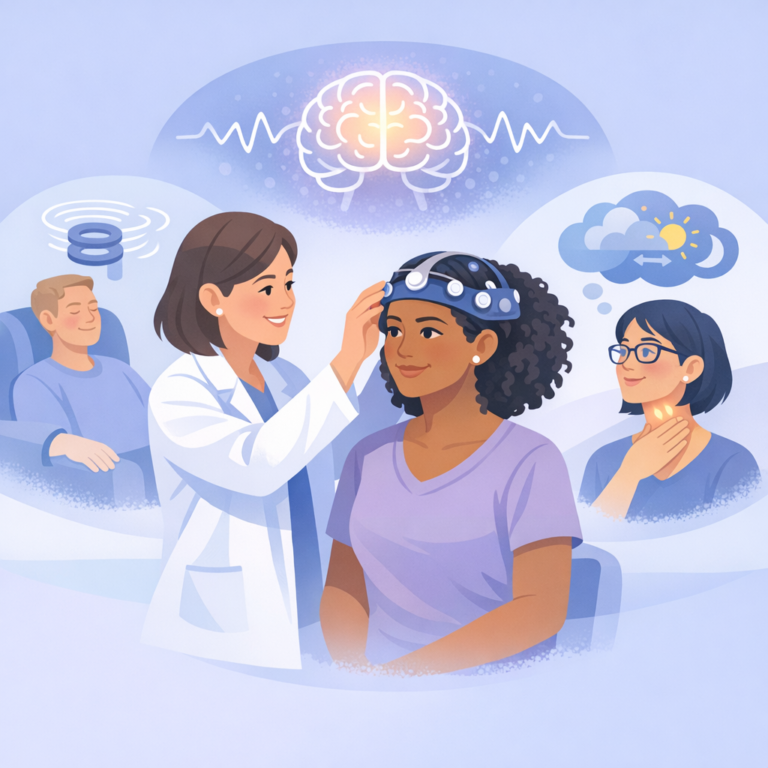
Brain Responses Change After Stimulation In Epilepsy
Source: Epilepsia
Summary
What was studied
Researchers looked at whether a brain signal called the corticocortical evoked potential, or CCEP, changes right away after brief brain stimulation in people with drug-resistant epilepsy.
The study included 17 patients who were already having stereoelectroencephalographic monitoring, which uses electrodes placed in the brain to help locate where seizures start. At different cortical brain sites, the researchers gave randomized short 5-second stimulation trains at either low frequency (7 Hz) or high frequency (100 Hz). They measured CCEPs before and after stimulation using 30-second 1-Hz trains, then compared 1,210 before-and-after CCEP pairs.
What they found
High-frequency stimulation produced greater reductions in CCEP amplitude than low-frequency stimulation. The median change was -1.6% after high-frequency stimulation versus about -0.02% after low-frequency stimulation, and this difference was statistically significant.
In the authors' analyses, the high-frequency effect was independent of total electrical charge and epileptiform activity. The changes persisted from minutes to more than an hour. High-frequency effects were most pronounced in the seizure onset zone, while low-frequency stimulation caused greater reductions in the mesial temporal region. The authors suggest that these relative changes in CCEP amplitude may reflect immediate, region-specific effects of neurostimulation and may have utility as a rapid marker for parameter optimization.
Limits of the evidence
This was a small study with 17 patients, all of whom were already undergoing invasive brain monitoring, so the results may not apply to all people with epilepsy. The study measured short-term changes in a brain signal, not whether seizures improved.
Because this was not a treatment trial, it cannot show that changing CCEP amplitude will lead to better seizure control or better long-term outcomes. The reported median changes in amplitude were also small, and more research is needed to know how useful this measure will be in routine care.
For families and caregivers
This study suggests there may be a quicker way to see how brain stimulation is affecting brain networks in epilepsy. If future studies confirm this, doctors might be able to adjust stimulation settings faster instead of relying only on longer trial-and-error periods.
For families, the main point is that this is early evidence about a possible tool for personalizing neurostimulation. It does not show that this method improves seizures yet, but it may help guide future treatment planning.
What to watch next
Larger studies could test whether using CCEP changes to guide stimulation settings is linked to better seizure outcomes over time.
Terms in this summary
- drug-resistant epilepsy
- Epilepsy in which seizures continue despite trying appropriate seizure medicines.
- neurostimulation
- Treatment that uses electrical stimulation of the nervous system to try to reduce seizures.
- corticocortical evoked potential (CCEP)
- A measured brain response after one brain area is electrically stimulated, used to study connections between brain regions.
- stereoelectroencephalographic monitoring
- A test in which thin electrodes are placed in the brain to record seizure activity and help find where seizures start.
- seizure onset zone
- The brain area where seizures are thought to begin.
- mesial temporal region
- A deep inner part of the temporal lobe, an area often involved in some types of epilepsy.
- epileptiform activity
- Brain wave patterns that suggest a tendency to have seizures.
- Hz
- Hertz, a unit that tells how many stimulation pulses happen each second.
Free: Seizure First Aid Quick Guide (PDF)
Plus one plain-language weekly digest of new epilepsy research.
Unsubscribe anytime. No medical advice.