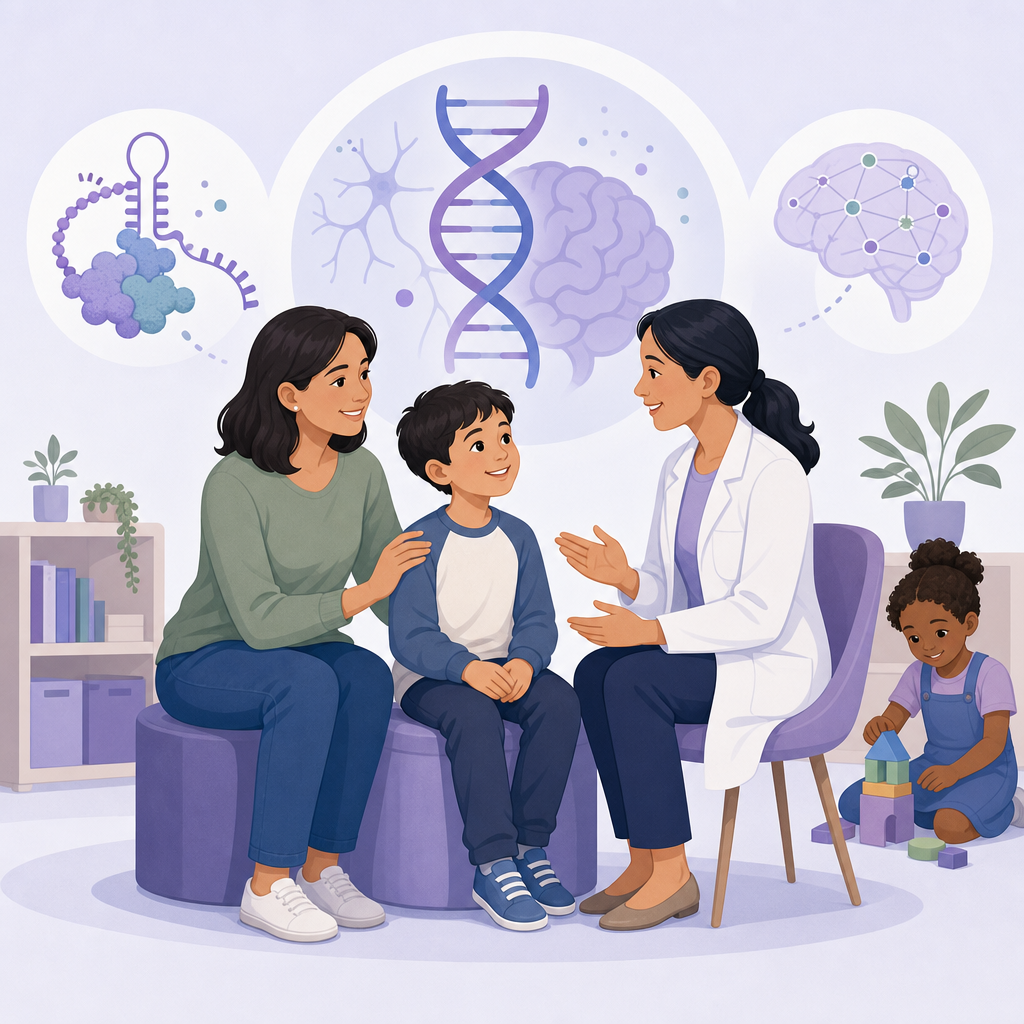
RNU2-2 Changes Linked To Childhood Movement Problems
Source: Annals of clinical and translational neurology
Summary
What was studied
Researchers analyzed genome sequencing data from 14 patients with undiagnosed pediatric movement disorders. They specifically looked for pathogenic variants in small nuclear RNA genes, which encode components of the spliceosome.
They identified two patients with recurrent de novo changes in the RNU2-2 gene. These two patients had intellectual disability, epilepsy, and hyperkinetic movement disorders. In one of the two patients, the researchers also studied RNA from fibroblasts.
What they found
The study identified recurrent de novo RNU2-2 variants (n.35A > G and n.4G > A) in 2 of 14 patients with undiagnosed pediatric movement disorders. Both patients had intellectual disability, epilepsy, and hyperkinetic movement disorders. RNA sequencing in fibroblasts from one patient did not show a characteristic transcriptomic signature.
Limits of the evidence
This was a small study, and only two patients with RNU2-2 variants were identified. Because of that, the study cannot define how common these variants are or the full range of associated features. The RNA analysis was performed in fibroblasts from only one patient, and it did not show a characteristic signature, so the molecular effects remain unclear. The findings support an association reported in these patients, but the abstract does not establish broader conclusions beyond this cohort.
For families and caregivers
For families, this study suggests that spliceosome-related disorders may be worth considering in some children with neurodevelopmental problems, epilepsy, and hyperkinetic movement features. It may offer a possible explanation in a small number of undiagnosed cases. However, this is based on only two patients in this report, so it should be viewed as an early finding that may help guide further genetic evaluation.
What to watch next
Useful next steps would include identifying more patients with similar RNU2-2 variants and studying RNA effects in additional samples and tissues.
Terms in this summary
- de novo
- A genetic change that is new in the child and was not inherited from either parent.
- spliceosome
- A cell machine that helps process RNA so genes can be used correctly.
- small nuclear RNA
- A type of RNA that helps the spliceosome do its job.
- spliceosomopathy
- A disorder related to problems in parts of the spliceosome.
- hyperkinetic movement disorder
- A condition with extra, unwanted body movements.
- fibroblasts
- Cells from connective tissue that can be studied in the lab.
- transcriptomic signature
- A recognizable pattern of RNA activity seen in a test.
Free: Seizure First Aid Quick Guide (PDF)
Plus one plain-language weekly digest of new epilepsy research.
Unsubscribe anytime. No medical advice.