Brain Inflammation Markers Change Quickly In NORSE And FIRES
Source: Seizure
Summary
What was studied
This paper was a systematic review, which means the authors gathered and summarized results from earlier studies rather than testing one new group of patients. It looked at people with new-onset refractory status epilepticus (NORSE) and febrile infection-related refractory status epilepticus (FIRES), both severe conditions involving refractory status epilepticus.
The review searched PubMed, Scopus, and Web of Science for studies published from January 1, 2006, to March 30, 2025, and included 42 studies that reported cytokine profiles in cerebrospinal fluid (CSF). The authors focused on how these immune signaling proteins changed over time, including before and/or after immunotherapies.
What they found
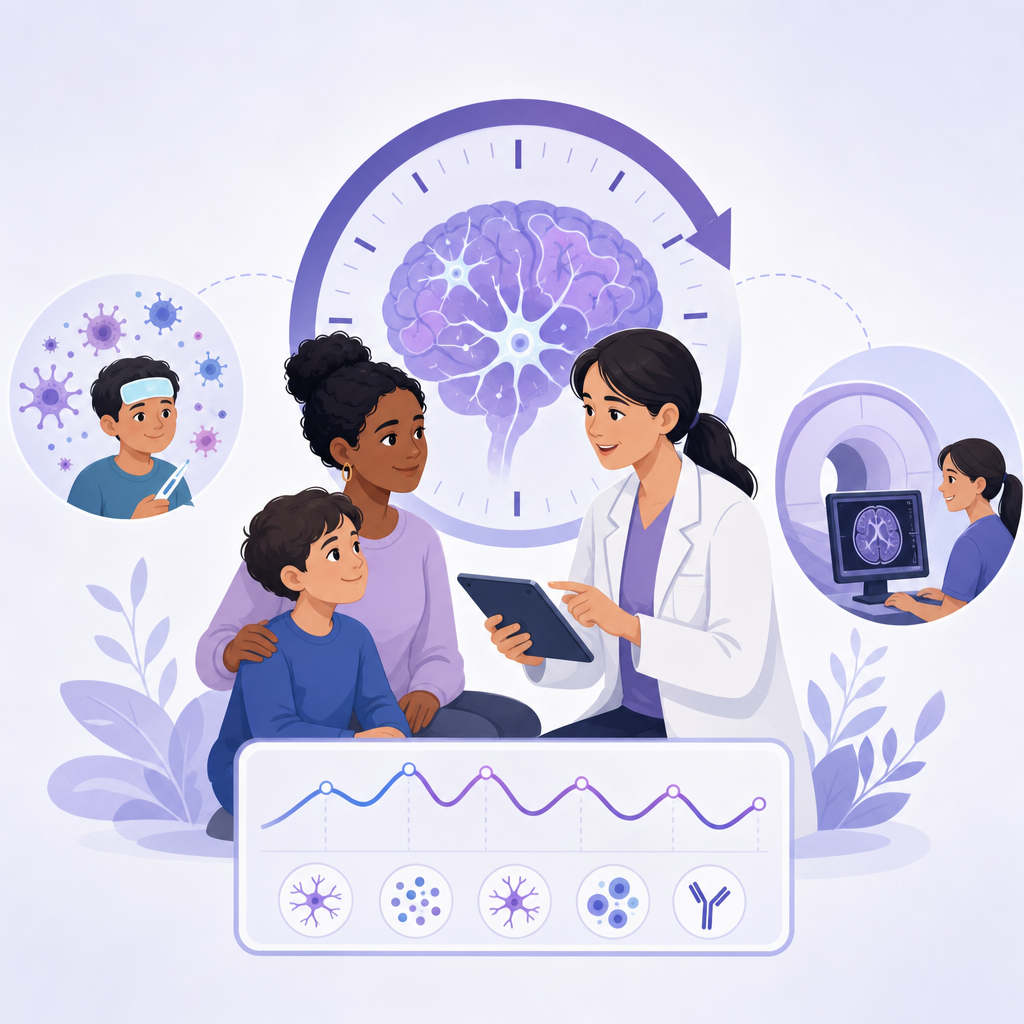
Across the studies, the CSF cytokines most consistently reported were IL-6, IL-8, and IL-1β. These markers showed temporal changes over the first weeks after seizure onset. IL-6 was highest early, with mean levels elevated in week 1 and then lower in weeks 2 and 3. IL-1β and IL-8 showed a different pattern: mean levels increased from week 1 to week 2 and then declined by week 3.
Overall, the review found that proinflammatory cytokines in CSF were markedly elevated within the first 2 weeks of NORSE and FIRES, and that timing is important when interpreting cytokine results.
Limits of the evidence
Because this was a review of published studies, it depends on the quality and consistency of those studies. The abstract does not say how many total patients were included, how similar they were, or how often the same cytokines were measured in the same way.
The findings show patterns over time, but they cannot prove that these cytokines cause NORSE or FIRES. The abstract also does not show whether changes in cytokine levels clearly predicted which immune treatments would work best.
For families and caregivers
For families, this study suggests that inflammatory signals in the spinal fluid are often highest early in NORSE and FIRES. It also suggests that test results from spinal fluid may mean different things depending on when the sample was taken.
This review highlights why timing may matter when doctors interpret cytokine test results and consider immune-based treatments.
What to watch next
Useful next steps would include larger studies that follow patients over time with repeated CSF testing and examine how cytokine patterns relate to treatment timing and outcomes.
Terms in this summary
- NORSE
- New-onset refractory status epilepticus, describing someone with no prior history of epilepsy who develops refractory status epilepticus.
- FIRES
- Febrile infection-related refractory status epilepticus, a subtype of NORSE with prior fever.
- status epilepticus
- A seizure emergency in which seizures are prolonged or repeated and need urgent treatment.
- cerebrospinal fluid (CSF)
- The fluid that surrounds the brain and spinal cord.
- cytokines
- Small proteins used by the immune system to send signals.
- immunotherapy
- Treatment aimed at modifying the immune response.
- IL-6
- A cytokine involved in immune and inflammatory responses.
- IL-1β
- A cytokine involved in inflammation.
Free: Seizure First Aid Quick Guide (PDF)
Plus one plain-language weekly digest of new epilepsy research.
Unsubscribe anytime. No medical advice.