Brain Wave Changes May Help Predict Epilepsy After Malaria
Source: Epilepsia
Summary
What was studied
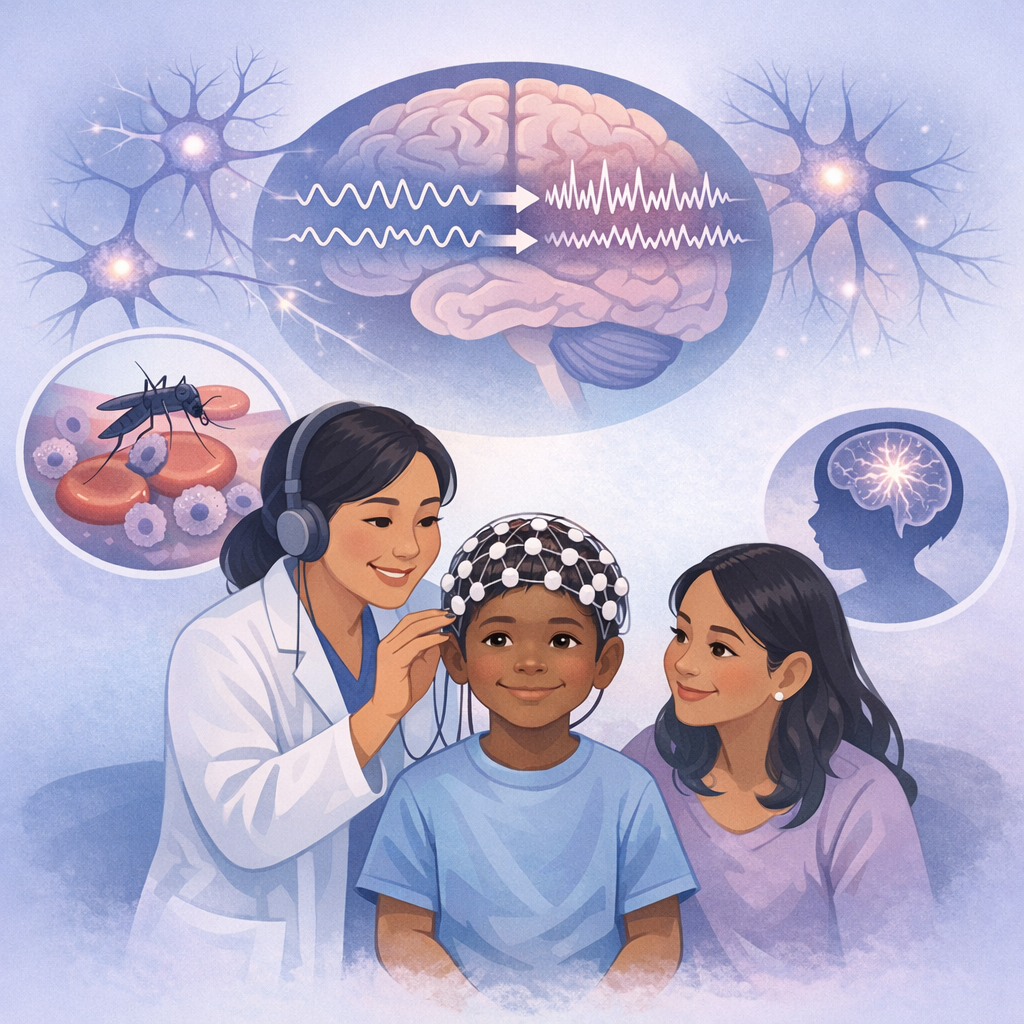
Researchers followed 186 children ages 6 months to 11 years in Chipata, Zambia who had confirmed central nervous system malaria. This was a prospective observational study, meaning the team watched what happened over time rather than testing a treatment. EEG recordings were collected during the acute illness for 179 children.
The children were then checked again at about 1 month, 6 months, and 12 months after leaving the hospital, with EEGs and clinical reviews. Follow-up included 155 children at 1 month, 144 at 6 months, and 142 at 12 months. Over 12 months, 26 children were diagnosed with postmalarial epilepsy.
What they found
Children who later developed postmalarial epilepsy had different EEG patterns from those who did not. At hospital admission, they had higher relative gamma power. But at 1 month and 6 months, gamma power was higher in the children who did not develop epilepsy. Alpha and beta power rose over time in both groups, which the authors suggest may reflect a prolonged process of neurologic recovery; by 12 months, alpha and beta power were higher in the children without epilepsy. Measures of EEG signal complexity (approximate entropy) were higher in the nonepilepsy group at admission, 1 month, and 6 months. Measures of how strongly brain signals matched across areas (beta and gamma coherence) were lower in the epilepsy group at admission and 1 month, not different at 6 months, and then more prominent again at 12 months. Overall, the study suggests some quantitative EEG measures may help with risk stratification after severe malaria.
Limits of the evidence
This study shows associations, not proof that these EEG changes cause epilepsy. It was observational and done at one site in Zambia, so the results may not apply the same way in other settings or age groups. Only 26 children developed postmalarial epilepsy, which limits certainty. Some children were lost to follow-up over time, and the abstract does not say how well these EEG measures predict risk for an individual child.
For families and caregivers
For families, this study suggests that EEG may someday help doctors identify children who could be at higher risk for epilepsy after severe malaria with neurologic involvement. It also suggests that brain recovery may continue for many months after the illness. But these findings are early and are not enough on their own to tell whether one child will or will not develop epilepsy.
What to watch next
Larger studies in multiple hospitals could help clarify how useful these EEG measures are for predicting later epilepsy in individual children.
Terms in this summary
- EEG
- A test that records the brain's electrical activity using sensors placed on the scalp.
- epileptogenesis
- The process by which the brain develops epilepsy after an injury or illness.
- postmalarial epilepsy
- Epilepsy that develops after a severe malaria illness affecting the central nervous system.
- gamma power
- The amount of fast brain-wave activity in a certain frequency range on an EEG.
- alpha and beta power
- Measures of brain-wave activity in other frequency ranges reported in this study.
- coherence
- A measure of how closely brain signals from different areas change together.
- approximate entropy
- A math measure of how complex or predictable an EEG signal is.
Free: Seizure First Aid Quick Guide (PDF)
Plus one plain-language weekly digest of new epilepsy research.
Unsubscribe anytime. No medical advice.