Some Children Diagnosed With Migraine May Have Seizures
Source: Neurology. Clinical practice
Summary
What was studied
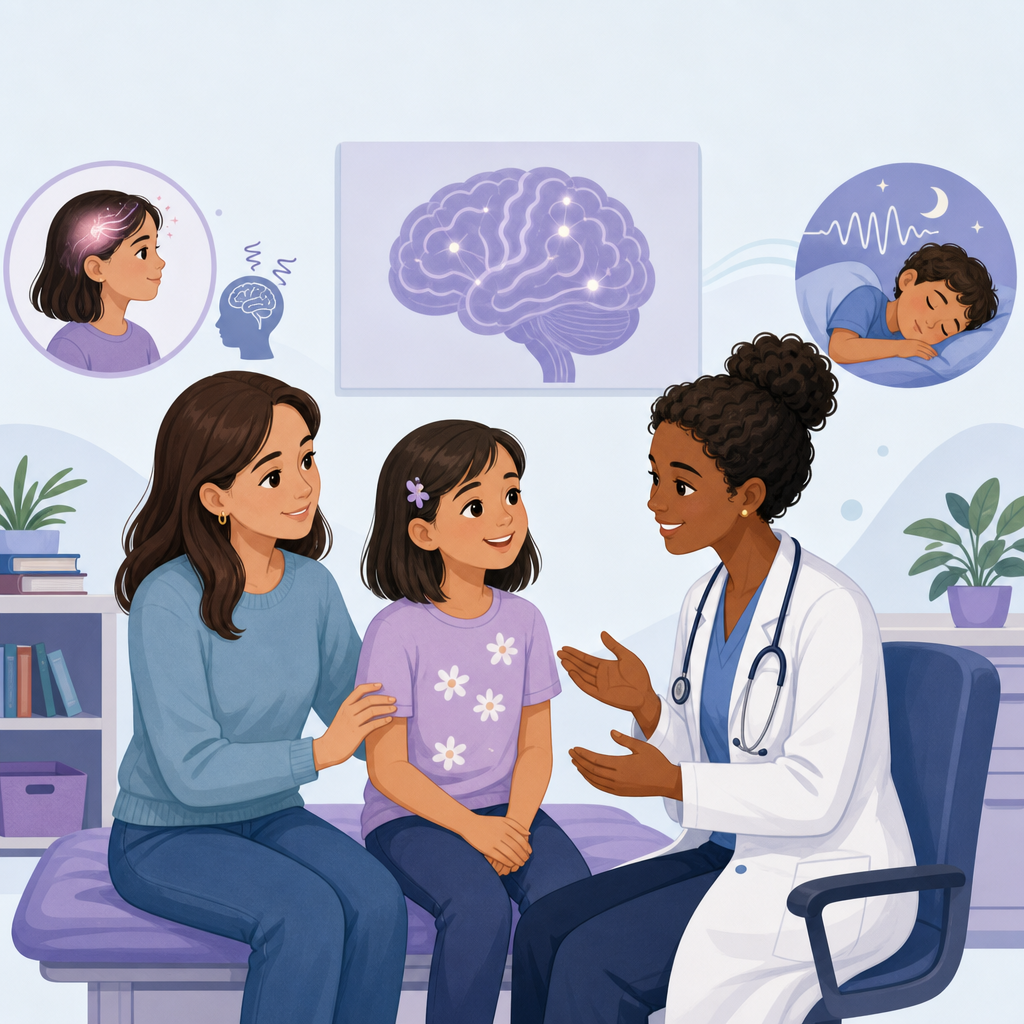
This study looked at whether some children sent to a pediatric neurology clinic for "migraine" or "headache" might actually have self-limited epilepsy with autonomic seizures (SeLEAS), also called Panayiotopoulos syndrome.
The researchers reviewed past records from 186 children ages 3 to 14 years who were referred over 2 years to a tertiary care university hospital. They used the children's clinical history, EEG results, and in some cases clear efficacy of antiseizure medication to assess whether SeLEAS was a possible diagnosis.
What they found
Among the 186 children first labeled as having migraine or headache, 12 children (6.5%) were ultimately diagnosed with SeLEAS. Three more children did not improve after treatment with only one antiseizure medication, so the diagnosis remained less certain. Another 23 children (12.4%) met the clinical and EEG criteria for SeLEAS but did not receive antiseizure medication. Overall, 35 children (18.8%) received a possible, probable, or definite diagnosis of benign focal epilepsy with autonomic seizures. The authors suggest SeLEAS should be considered more often as a differential diagnosis when children and adolescents present with headache attacks, because it can resemble migraine.
Limits of the evidence
This was a retrospective chart review, so it depended on what was written in past records and does not show how often misdiagnosis occurs in all settings. The study was done at one tertiary care university hospital, where referred patients may differ from children seen in other settings. Some diagnoses were labeled possible or probable rather than definite, and part of the diagnostic assessment relied on response to antiseizure medication. The abstract does not provide detailed symptom patterns, long-term follow-up, or a direct comparison group of children with confirmed migraine only.
For families and caregivers
For families, this study suggests that some children with a prior label of "migraine" or repeated headache episodes may also fit a diagnosis of SeLEAS, a type of epilepsy syndrome. That matters because evaluation and treatment may differ. This does not mean most children with headaches have epilepsy, but it supports asking whether the overall pattern of symptoms has been fully assessed.
What to watch next
Larger prospective studies could help clarify how often children referred for migraine or headache meet criteria for SeLEAS and how best to distinguish the two in practice.
Terms in this summary
- SeLEAS
- Self-limited epilepsy with autonomic seizures, a childhood epilepsy syndrome.
- Panayiotopoulos syndrome
- An older name for SeLEAS.
- EEG
- A test that records the brain's electrical activity and can show patterns linked to seizures.
- autonomic seizures
- Seizures involving autonomic symptoms.
- ictal
- Happening during a seizure.
- postictal
- Happening after a seizure.
- antiseizure medication
- Medicine used to treat seizures.
- retrospective review
- A study that looks back at existing medical records rather than following patients forward in time.
Free: Seizure First Aid Quick Guide (PDF)
Plus one plain-language weekly digest of new epilepsy research.
Unsubscribe anytime. No medical advice.