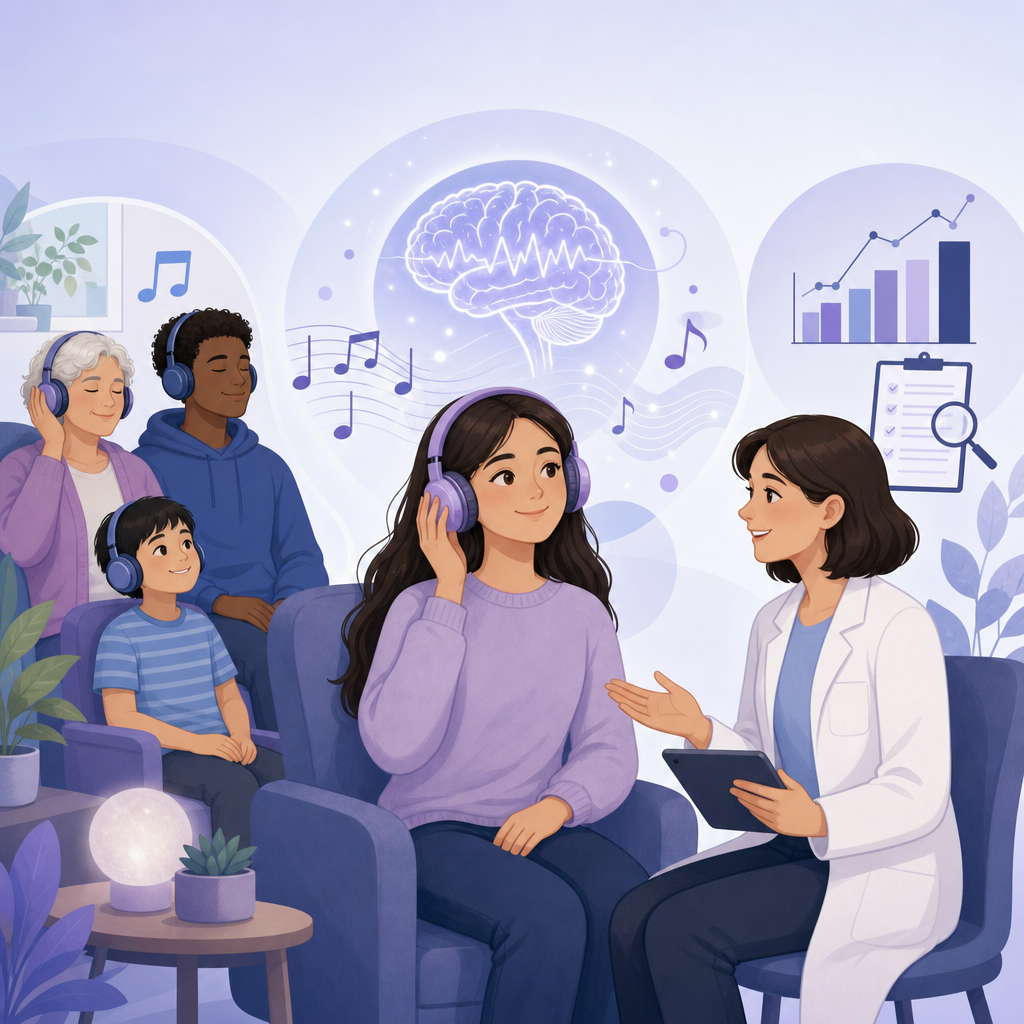
Music May Help Seizures, But Proof Is Unclear
Source: Epilepsy & behavior : E&B
Summary
What was studied
This study reviewed research on whether music interventions might help people with epilepsy with seizure outcomes or abnormal brain-wave events. The authors searched several English and Chinese databases and trial registries through October 11, 2025.
They included 15 studies. Some studies only looked at people before and after a music intervention, while others compared a music intervention with a control group. The abstract does not give clear details about the ages of participants, the types of epilepsy, or the exact music programs used in each study.
What they found
When studies looked at people before and after music treatment without a comparison group, results suggested possible benefit. On average, these studies showed a pooled "curative-effect" rate of 0.715 and a reduction in interictal epileptiform discharges, which are abnormal EEG signals between seizures.
But when the analysis focused on studies that compared music with a control group, the results were inconclusive. The estimates for seizure response, EEG responder rates, EEG abnormality frequency, and seizure frequency were imprecise and varied a lot from study to study. Overall, the review concluded that music interventions show promising within-study effects on seizure outcomes, but the controlled evidence does not clearly show benefit because of high heterogeneity and imprecision.
Limits of the evidence
This review cannot show clearly from controlled studies that music interventions improve seizure outcomes. Many included studies were small, and the comparison groups varied. Results differed widely across studies, which makes the pooled findings harder to interpret.
The controlled results had wide confidence intervals, meaning there was substantial uncertainty. The findings also changed depending on which individual study was included. The abstract does not provide enough detail to know which patients, music types, or treatment schedules might work best.
For families and caregivers
Families may find this encouraging because music interventions are being studied as a possible add-on approach for epilepsy. The review suggests there may be benefits, especially in studies that measured people before and after treatment.
At the same time, the best evidence comes from fair comparison studies, and that evidence is still inconclusive. This means music should not be seen as a proven way to control seizures based on this review alone, but it may be a topic to discuss with an epilepsy clinician as part of a broader care plan.
What to watch next
Stronger evidence would come from high-quality, adequately powered randomized trials that use standardized music interventions and compare them with matched active controls.
Terms in this summary
- systematic review
- A study that collects and evaluates all relevant research on a question using planned methods.
- meta-analysis
- A method that combines results from multiple studies to estimate an overall effect.
- interictal epileptiform discharges
- Abnormal electrical patterns on an EEG that happen between seizures.
- EEG
- A test that records the brain's electrical activity.
- randomized trial
- A study where people are assigned by chance to different treatments to make comparisons fairer.
- heterogeneity
- Differences in results across studies.
- confidence interval
- A range that shows how uncertain an estimate is; a wide range means more uncertainty.
- active control
- A comparison treatment designed to match attention or activity, rather than giving no treatment at all.
Free: Seizure First Aid Quick Guide (PDF)
Plus one plain-language weekly digest of new epilepsy research.
Unsubscribe anytime. No medical advice.