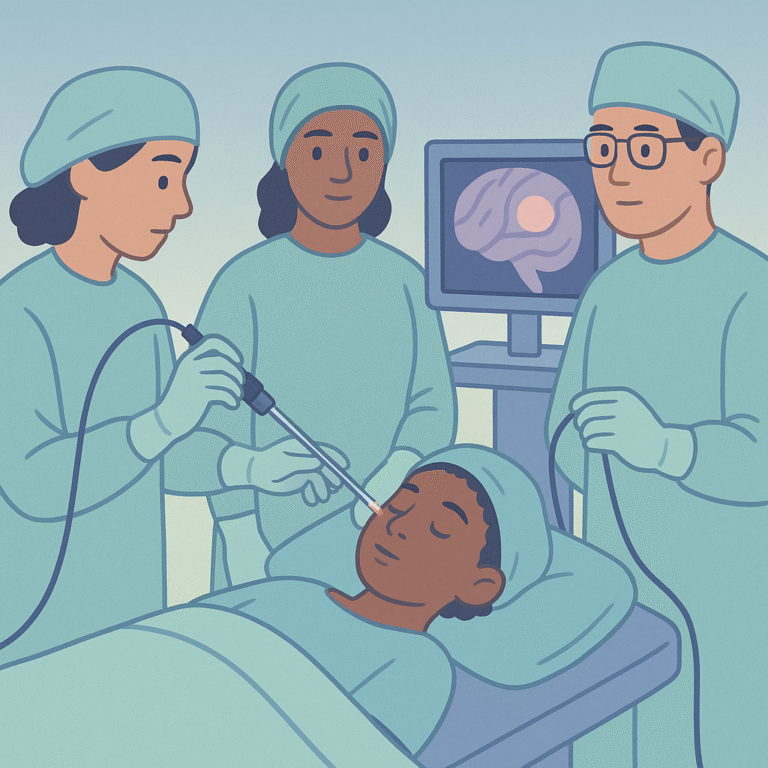
Less Invasive Brain Treatment Option For Infant Seizures
⚠️ Infant dosing/safety: medication and diet decisions for infants require individualized medical guidance.
Source: Seizure
Summary
What was studied
No abstract was provided. Based on the draft, this appears to be a medical case report involving an infant with tuberous sclerosis complex (TSC) and hemimegalencephaly, and it mentions hemispheric endovascular embolization in relation to hemispherectomy.
Without the abstract, there are no details about the infant's age, symptoms, seizure type, how the procedure was done, or what happened afterward.
What they found
No abstract was provided, so the findings cannot be confirmed. The title or draft wording suggests the report may discuss hemispheric endovascular embolization in an infant with TSC-related hemimegalencephaly in relation to hemispherectomy, but the actual results, benefits, risks, seizure outcomes, and follow-up are unknown.
Limits of the evidence
Because no abstract is available, there is very limited information. If this is a single-patient case report, it would be very limited for judging how safe or effective a treatment is for other children. It also would not be enough to show whether this approach is better than standard surgery or other treatments. Important details such as complications, long-term development, and seizure control are not provided.
For families and caregivers
For families, this suggests doctors may be considering different treatment approaches for severe epilepsy linked to major brain differences in very young children. But without the abstract, this is not enough to know whether this option is effective, how often it is used, or which children might be candidates.
What to watch next
The most helpful next information would be the full abstract or full report, especially details on outcomes, complications, and follow-up. Families may also want to ask a child's epilepsy team what evidence exists for embolization and hemispherectomy in similar situations.
Terms in this summary
- tuberous sclerosis complex
- A genetic condition that can cause growths in different organs, including the brain, and often leads to seizures.
- hemimegalencephaly
- A rare brain condition in which one side of the brain is abnormally large and formed differently, often causing severe seizures.
- endovascular embolization
- A procedure in which doctors guide tiny tubes through blood vessels and block selected vessels to reduce blood flow to a target area.
- hemispherectomy
- A major brain surgery that disconnects or removes much of one side of the brain to treat severe seizures.
Free: Seizure First Aid Quick Guide (PDF)
Plus one plain-language weekly digest of new epilepsy research.
Unsubscribe anytime. No medical advice.