Brain Device Reduced Seizures For Many Children With LGS
Source: Epilepsia open
Summary
What was studied
This study looked at outcomes of responsive neurostimulation (RNS) in people with Lennox-Gastaut syndrome (LGS), a severe epilepsy that is often hard to control with medicine. It was a retrospective multicenter study, meaning the researchers reviewed past medical records.
The study included 37 patients treated at 4 major epilepsy centers in the United States. Most were pediatric patients: 95% were pediatric, with an average age of 12.9 years at the time of RNS implant. Patients were followed for a median of 24.5 months. All had generalized tonic seizures, and many also had other seizure types.
What they found
The pooled responder rate was 62%, meaning about 62% of patients had at least a 50% reduction in seizures after RNS. About 10% had a reduction of 90% or more. The most common device setup was thalamic-only stimulation of both centromedian nuclei, and among responders, most had this thalamic-only approach.
Antiseizure medicine reduction occurred in 10% of patients. Adverse events were reported in 13%, mostly implant-related infections, and 4 patients required device explantation. Stimulation-related side effects occurred in 27%, and most of these resolved after programming adjustments.
Limits of the evidence
This was a small retrospective study with 37 patients, and the abstract says evidence on safety and effectiveness in LGS remains limited. There was no comparison group described in the abstract.
Most patients were pediatric, so the findings may not apply in the same way to adults with LGS. The abstract does not report details on quality of life, cognition, behavior, or which patients were most likely to benefit. It also does not fully compare outcomes across different electrode targets or seizure types.
For families and caregivers
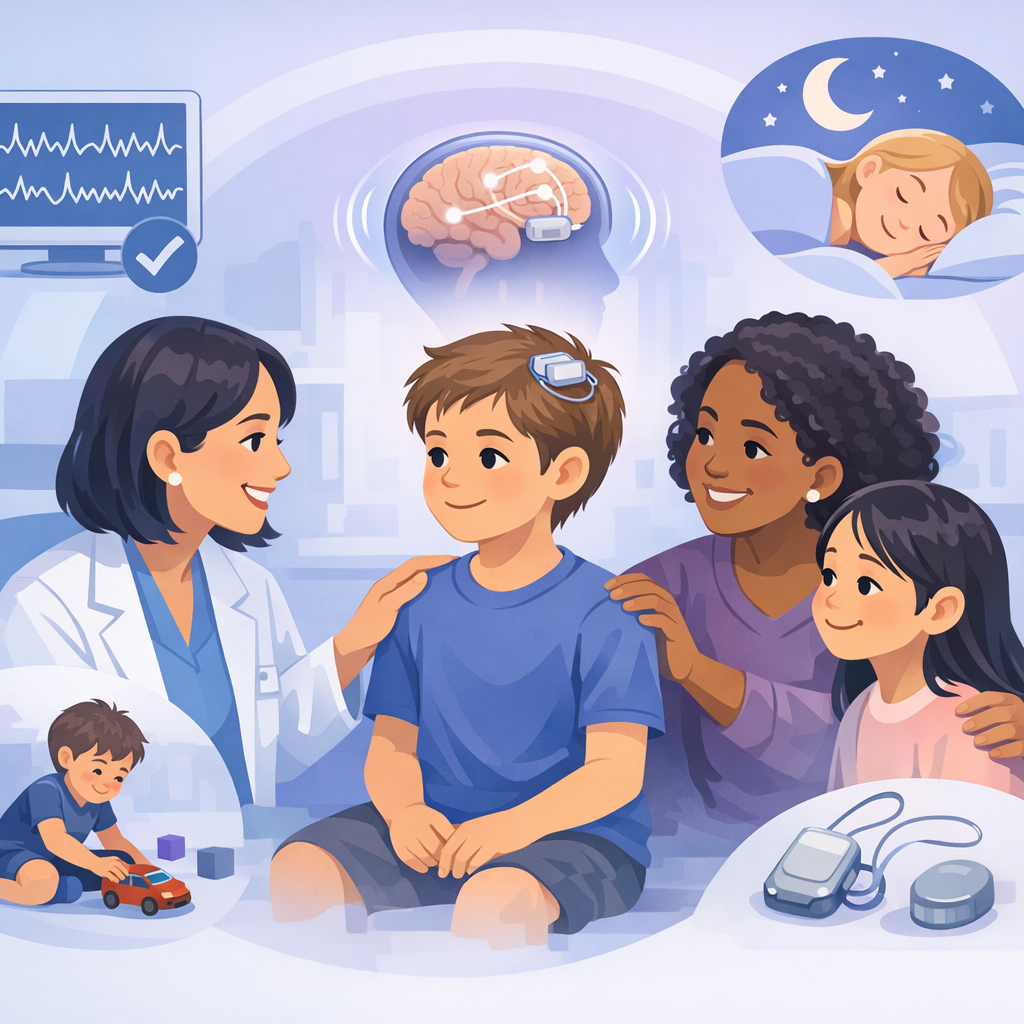
For families dealing with LGS that has not responded well to medicines, this study suggests that RNS may help reduce seizures in some patients. In this mostly pediatric group, many side effects related to stimulation were managed with device programming changes, although infections and device removal did occur in some patients.
This does not mean RNS will work for every child or adult with LGS, and the abstract describes it as a potential adjunctive treatment option for drug-resistant epilepsy. Families may see this as real-world evidence that RNS is one possible option to discuss with a specialized epilepsy team.
What to watch next
Larger studies could help clarify safety and effectiveness, compare outcomes across different targets, and report more on daily function, quality of life, and which patients may benefit most.
Terms in this summary
- Lennox-Gastaut syndrome
- A severe epilepsy syndrome that usually begins in childhood and involves multiple seizure types.
- responsive neurostimulation
- An implanted device that monitors brain activity and delivers electrical stimulation in response to detected activity.
- drug-resistant epilepsy
- Epilepsy that remains difficult to control despite treatment with seizure medicines.
- neuromodulation
- Treatment that changes nerve activity using electrical stimulation.
- thalamus
- A deep brain structure involved in brain signaling networks.
- centromedian nucleus
- A specific part of the thalamus that can be targeted in seizure treatment.
- responder rate
- The percentage of patients who had a meaningful improvement, here defined as at least a 50% reduction in seizures.
- retrospective study
- A study that looks back at existing medical records instead of following patients forward in a planned trial.
Free: Seizure First Aid Quick Guide (PDF)
Plus one plain-language weekly digest of new epilepsy research.
Unsubscribe anytime. No medical advice.