Brain Stimulation Measures May Help Test New Seizure Medicines
Source: Clinical pharmacology and therapeutics
Summary
What was studied
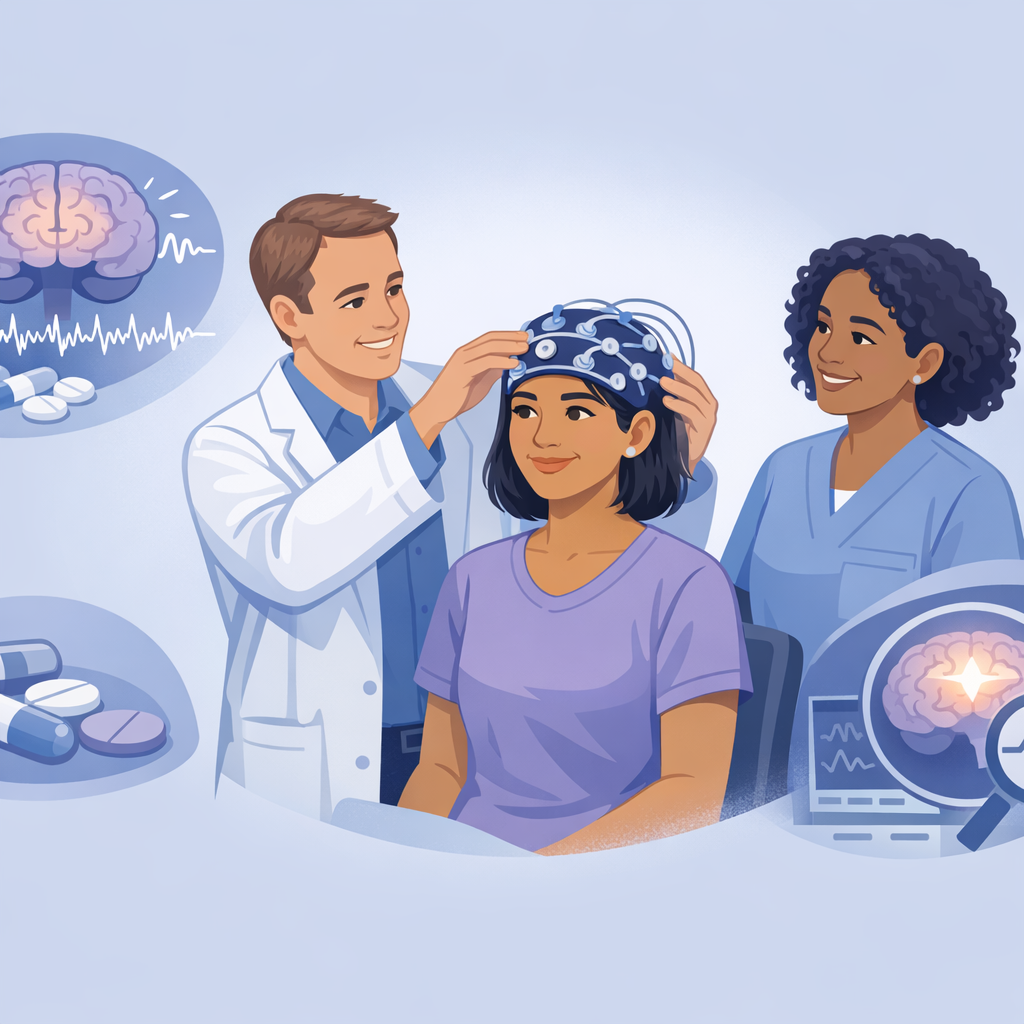
Researchers tested whether brain stimulation and brain-wave measures could detect the short-term effects of levetiracetam, an anti-seizure medicine, in people with generalized epilepsy. The goal was not to test long-term seizure control, but to see if these tests could work as early "biomarkers" showing that a medicine is affecting the brain.
The study included 26 patients in total. Fourteen were already taking levetiracetam regularly, and 12 were taking valproic acid and had not used levetiracetam before. In a randomized, double-blind, placebo-controlled crossover study, each person received a single 2000 mg dose of levetiracetam on one visit and placebo on another visit. Participants were asked to skip their morning anti-seizure medicine dose to reduce background drug levels while maintaining seizure protection. Researchers measured responses before the dose and again 1.5 and 3 hours later using transcranial magnetic stimulation (TMS), muscle recording (EMG), brain-wave recording (EEG), and resting-state EEG.
What they found
A single dose of levetiracetam changed several test results. It reduced motor-evoked potential amplitude, increased long-interval intracortical inhibition, and increased frontal beta and gamma EEG power. The effects were larger in patients who had not already been taking levetiracetam.
The study also found linear concentration-response relationships for these measures. TMS-EEG results showed different patterns between the two groups: people already on levetiracetam showed modulation of earlier brain responses, while levetiracetam-naive patients showed modulation of later responses. Overall, the authors conclude that some TMS- and EEG-based measures may be promising early biomarkers of levetiracetam's acute effects in epilepsy drug development.
Limits of the evidence
This was a small study with only 26 participants, so the findings need confirmation in larger groups. It looked at the short-term effects of one dose, not long-term treatment or seizure outcomes. Because the participants had generalized epilepsy and were split into two treatment groups, the results may not apply to all people with epilepsy or to other anti-seizure medicines.
The study shows that these tests changed after levetiracetam, but it cannot show that these biomarkers predict who will have fewer seizures or do better clinically. Some differences between groups may also relate to their background medicines or prior exposure to levetiracetam.
For families and caregivers
This study suggests that TMS and EEG might help researchers tell early on whether an anti-seizure medicine is affecting the brain. If these kinds of biomarkers are validated, they could help support early drug testing and decisions about which medicines to study further.
For families, this does not mean TMS or EEG from this study can guide treatment choices now. The main importance is in research: these tools may someday make epilepsy drug development more efficient, but more evidence is needed before they can be used to predict benefit for an individual patient.
What to watch next
Stronger evidence would come from larger studies that test whether these TMS and EEG changes are also associated with clinical outcomes such as seizure reduction or side effects.
Terms in this summary
- transcranial magnetic stimulation (TMS)
- A noninvasive test that uses magnetic pulses on the scalp to briefly activate parts of the brain.
- biomarker
- A measurable sign that shows a biological process or a drug effect in the body or brain.
- placebo-controlled
- A study design where the treatment is compared with an inactive look-alike treatment.
- double-blind
- A study design where neither the participants nor the researchers know who gets the active treatment at the time of testing.
- crossover study
- A study in which the same person receives both the active treatment and the placebo at different times.
- EEG
- A test that records the brain's electrical activity using sensors on the scalp.
- EMG
- A test that records electrical activity from muscles.
- long-interval intracortical inhibition (LICI)
- A TMS measure that reflects how strongly the brain's cortex can damp down or inhibit activity.
Free: Seizure First Aid Quick Guide (PDF)
Plus one plain-language weekly digest of new epilepsy research.
Unsubscribe anytime. No medical advice.