Brain Activity Before Stimulation Helps Predict Responses
Source: Brain stimulation
Summary
What was studied
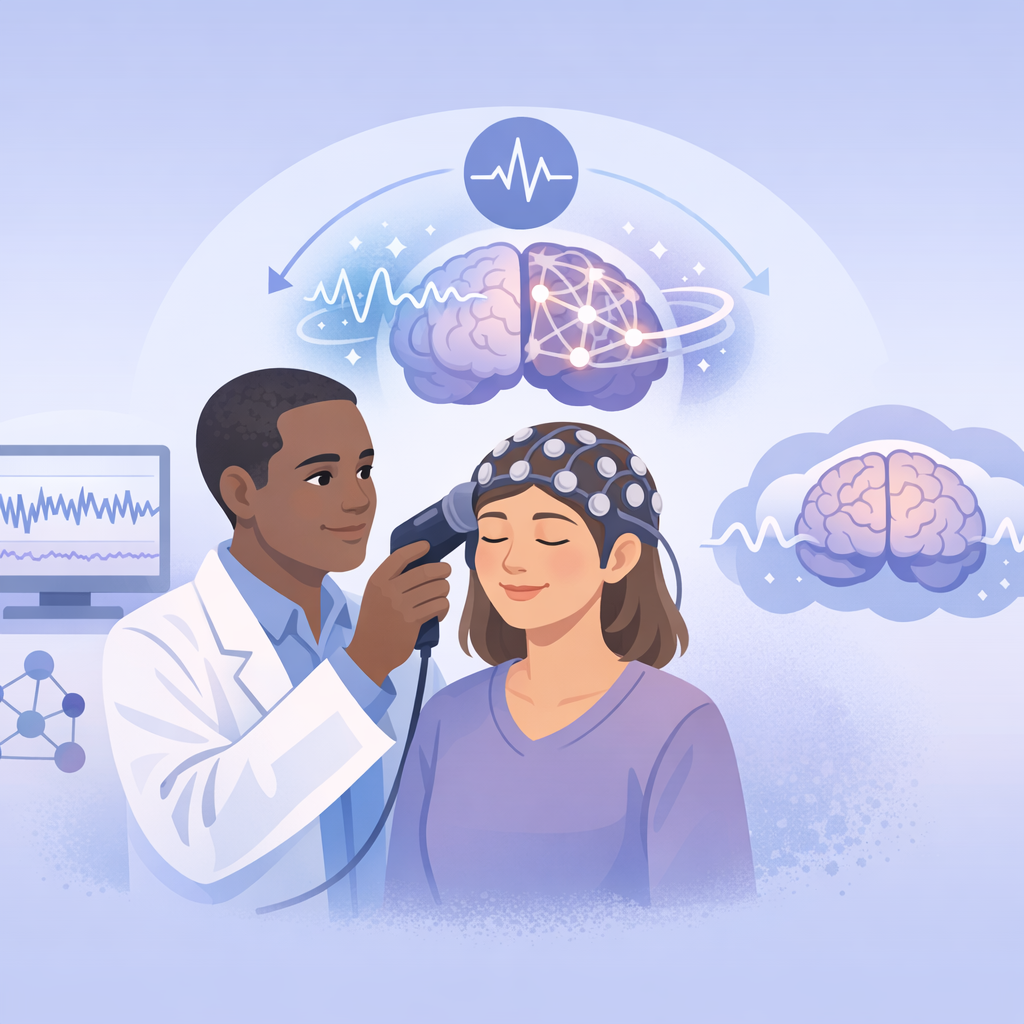
Researchers looked at whether the brain's activity just before an electrical stimulation pulse can help explain why the response to that pulse changes from one trial to the next.
The study included 36 people with epilepsy who were already having brain recordings. The researchers used two kinds of recordings at the same time: high-density EEG from the scalp and stereotactic EEG (SEEG) from electrodes placed in the brain. Across about 320 sessions, they analyzed more than 10,000 single-pulse electrical stimulations. They screened 127 possible pre-stimulation brain measures, then focused the main analyses on the 5 most reliable ones, including measures of signal dynamics, synchronization, connectivity, and complexity at both local and whole-brain levels.
What they found
The brain state before stimulation explained part of the difference in how strongly the brain responded afterward. On average, this explained more of the response in SEEG than in scalp EEG. Whole-brain measures worked better than local measures in both recording types.
The researchers also found that prediction sometimes worked on new data from the same sessions, although this was not true in every session. In SEEG, positive generalization was seen on average in 42.1% of sessions, compared with 19.0% of high-density EEG sessions.
Response predictability also differed by brain network. In SEEG, primary brain systems showed more explained variance than higher-order networks. In retrospective and prospective closed-loop analyses, conditioning stimulation on more favorable pre-stimulation brain states was associated with lower variability in post-stimulation responses.
Limits of the evidence
This study was done in people with epilepsy who were already undergoing invasive and noninvasive brain recordings, so the results may not apply to people without epilepsy or to other patient groups.
Even though the study found links between pre-stimulation brain state and stimulation response, it does not show that these measures will reliably control outcomes in routine clinical care. The abstract does not report effects on symptoms, safety, or long-term treatment results. Prediction also did not generalize in every session, especially for scalp EEG, so the approach may not work consistently.
The abstract gives summary results but not all details about the exact stimulation settings, patient differences, or how the 5 final measures were selected, so some uncertainty remains.
For families and caregivers
This study suggests that brain stimulation responses are not completely random. The brain's condition right before a stimulation pulse may help explain why the same settings can produce different results at different times.
For families, this may matter because future brain stimulation systems might work better if they adjust to the person's current brain state instead of using fixed settings alone. That could someday make stimulation more consistent. But this study does not show direct patient benefit yet, and more work is needed before this idea becomes standard care.
What to watch next
Stronger evidence would come from studies showing whether state-aware stimulation improves real-world outcomes compared with standard fixed stimulation.
Terms in this summary
- EEG
- A test that records the brain's electrical activity using sensors on the scalp.
- SEEG
- A type of brain recording that uses electrodes placed inside the brain to measure activity more directly.
- pre-stimulus
- What the brain is doing just before a stimulation pulse is given.
- evoked response
- The brain activity that happens after a stimulation pulse.
- functional connectivity
- A measure of how activity in different brain areas changes together.
- closed-loop
- A system that changes when or how stimulation is given based on real-time brain signals.
- whole-brain measures
- Measures that use information from many brain areas together, rather than from just one spot.
- variance
- How much responses differ from one trial to another.
Free: Seizure First Aid Quick Guide (PDF)
Plus one plain-language weekly digest of new epilepsy research.
Unsubscribe anytime. No medical advice.