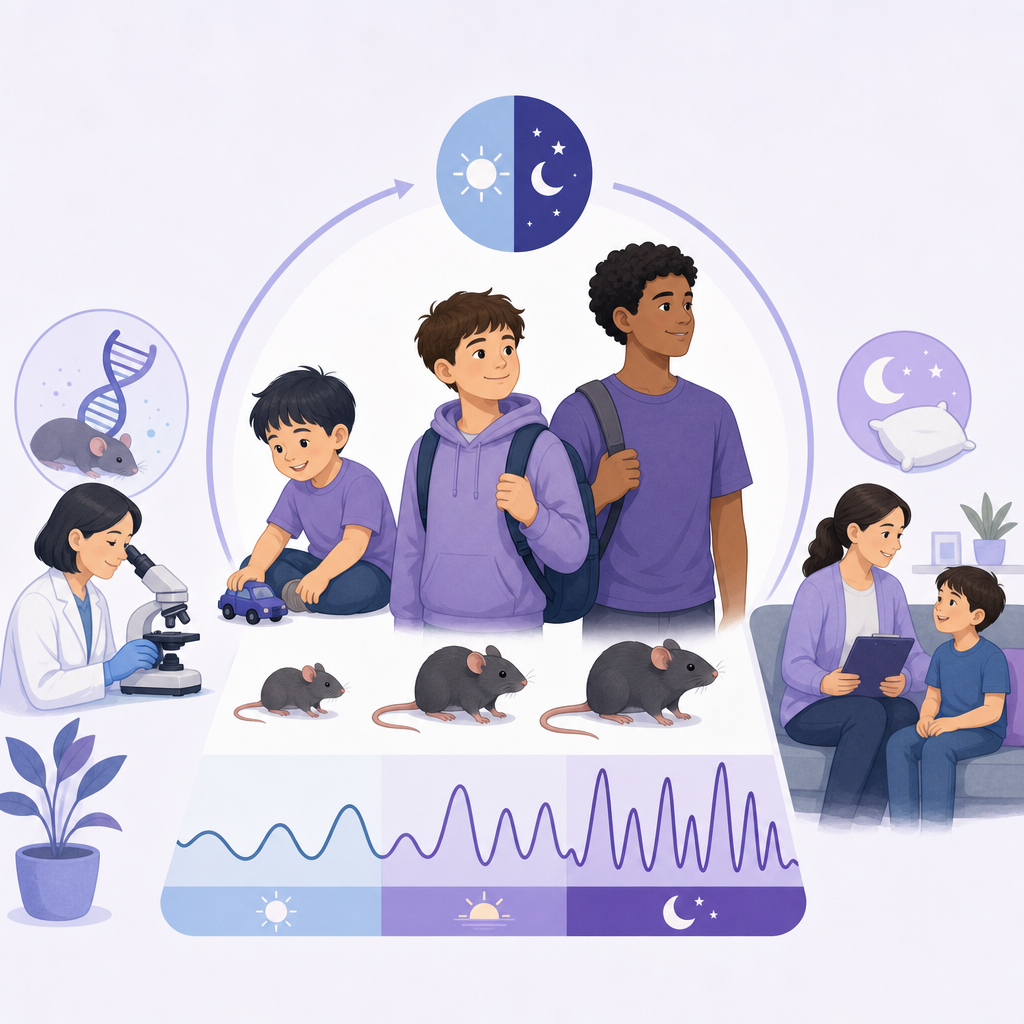
Activity Changes Differ By Age In Autism Mouse Models
Source: Epilepsia open
Summary
What was studied
Researchers studied rest-activity patterns in two genetic mouse models relevant to autism spectrum disorder and epilepsy: Syn2 knockout mice and Cntnap2 knockout mice. They also included wild-type mice for comparison. In total, they monitored 25 Syn2 knockout mice, 32 Cntnap2 knockout mice, and 31 wild-type mice, including both males and females.
The mice were tested at different ages: 1-2 months, 3-5 months, and 5-7 months. The researchers used actigraphy, a noninvasive way to track movement, and recorded activity continuously for 72 hours during a regular 12-hour light/12-hour dark schedule after a 12-hour acclimatization period. The goal was to examine whether rest-activity patterns changed with age in these two mouse models, including around the ages when seizures typically emerge in each model.
What they found
Across all groups and ages, mice were more active during the dark phase, supporting that the light phase was their usual rest period. Syn2 knockout mice showed normal rest-activity patterns at 1-2 months, but at 3-5 months they showed increased activity during the dark phase, meaning they were more active during their usual wake period. This age range coincides with when seizures typically emerge in this model.
For Cntnap2 knockout mice, the researchers did not detect robust age-dependent changes in rest-activity patterns after correction for multiple comparisons. In simple terms, this model did not show clear, consistent developmental changes in activity in this study.
Limits of the evidence
This was an animal study in mice, so it cannot show directly what happens in people with autism or epilepsy. The study measured movement patterns, not sleep itself, so it cannot fully determine whether the mice had true sleep disturbances. Increased activity is not the same as a diagnosed sleep disorder.
The findings also differed by gene model, which means results from one model may not apply to another. The abstract does not report detailed seizure measurements from the same recordings, so the study cannot show that the activity changes were caused by seizures or that they predict seizures. It also does not establish cause and effect between rest-activity changes and autism-related features.
For families and caregivers
This study may matter because sleep and activity problems are common in autism and epilepsy, and the research suggests these patterns may differ depending on the specific gene involved and the age of development. In one mouse model, changes in activity appeared around the same life stage when seizures typically emerge, which may help researchers think about when symptoms appear.
For families, the main takeaway is that sleep and activity changes in autism and epilepsy may not look the same in every condition. This study adds to basic knowledge, but it does not tell families how to predict seizures or how to treat sleep problems in people.
What to watch next
Useful next steps would include studies that directly measure sleep stages and seizures at the same time, and human studies examining whether similar age-related patterns appear in people with specific genetic conditions.
Terms in this summary
- autism spectrum disorder
- A developmental condition that affects communication, behavior, and social interaction in different ways.
- epilepsy
- A brain condition that causes repeated seizures.
- knockout mice
- Mice that are bred so they do not have a specific gene, allowing researchers to study what that gene does.
- actigraphy
- A method that tracks movement over time to estimate patterns of rest and activity.
- genotype
- A person's or animal's genetic makeup, or which gene changes they carry.
- wild-type
- Animals without the studied gene change, used as a comparison group.
- multiple comparisons
- A statistical issue that happens when many tests are done; researchers correct for it to reduce the chance of false-positive results.
Free: Seizure First Aid Quick Guide (PDF)
Plus one plain-language weekly digest of new epilepsy research.
Unsubscribe anytime. No medical advice.