Deep Brain Stimulation For Children With Hard-To-Treat Epilepsy
Source: Neurotherapeutics : the journal of the American Society for Experimental NeuroTherapeutics
Summary
What was studied
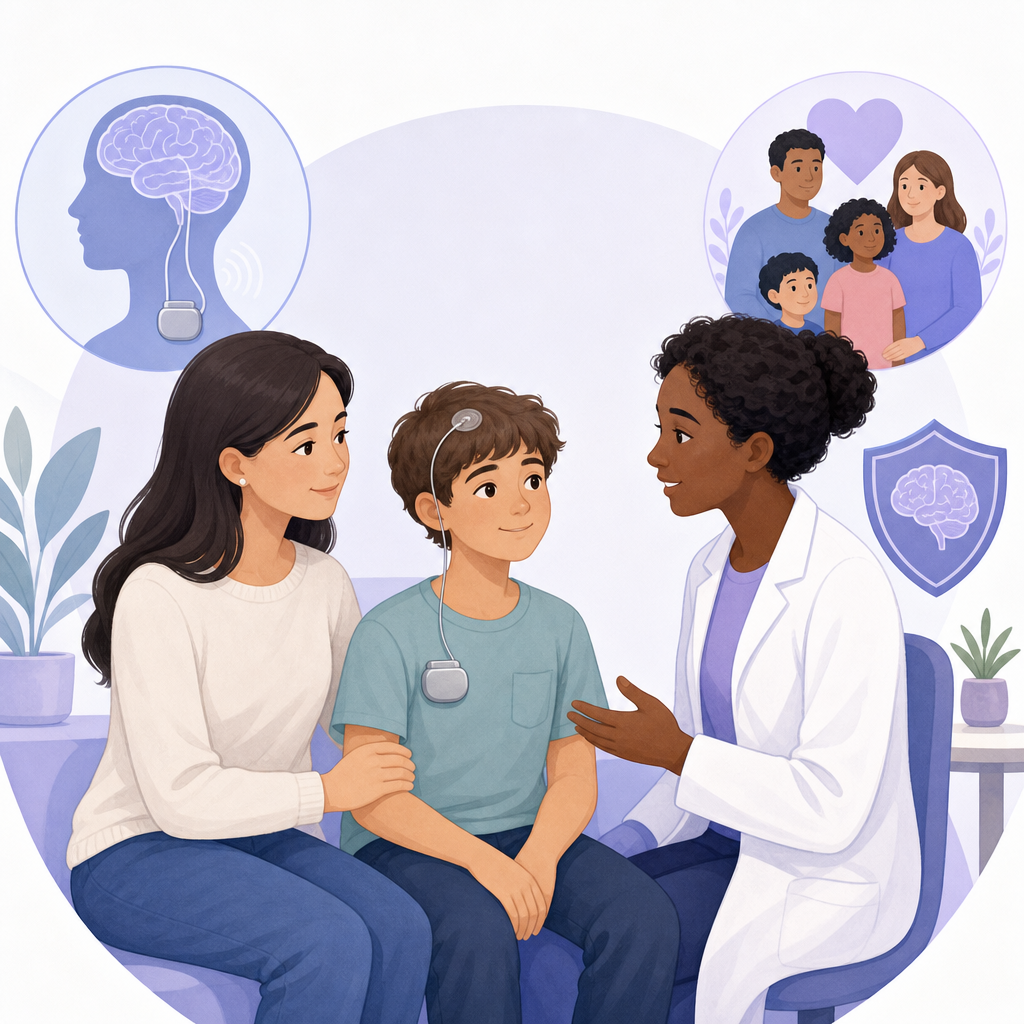
This paper is a review, not a new experiment. It examined what is known so far about deep brain stimulation (DBS) for children and adolescents with drug-resistant epilepsy, meaning seizures that do not respond well to medicines.
The review focused on the neurobiological rationale for DBS based on brain networks, especially thalamic and limbic targets, and summarized published clinical evidence on seizure outcomes, quality of life, safety, and neurodevelopment over time. It also discussed surgical, clinical, and ethical issues that are especially important in a still-developing brain.
What they found
The review says DBS is increasingly being incorporated into specialized epilepsy care for some young people with drug-resistant epilepsy, even though pediatric use remains largely off-label. Current evidence supports a neurobiological rationale for studying DBS, especially in thalamic and limbic networks involved in seizures.
The authors describe available clinical data, including emerging prospective studies, with attention to seizure outcomes, quality of life, neurodevelopmental trajectories, and safety. However, they also state that the overall evidence base is limited and lacks high-quality support. Long-term effects on brain development and psychosocial outcomes remain important areas of uncertainty.
Limits of the evidence
Because this is a review, it cannot establish how well DBS works or how safe it is for all children. The abstract does not provide patient numbers or detailed study results, so it is not possible to judge the size of possible benefits or risks.
The authors state that pediatric DBS is supported by limited high-quality evidence. Questions remain about long-term safety, effects in the developing brain, target selection, and the need for developmentally relevant long-term outcome measures.
For families and caregivers
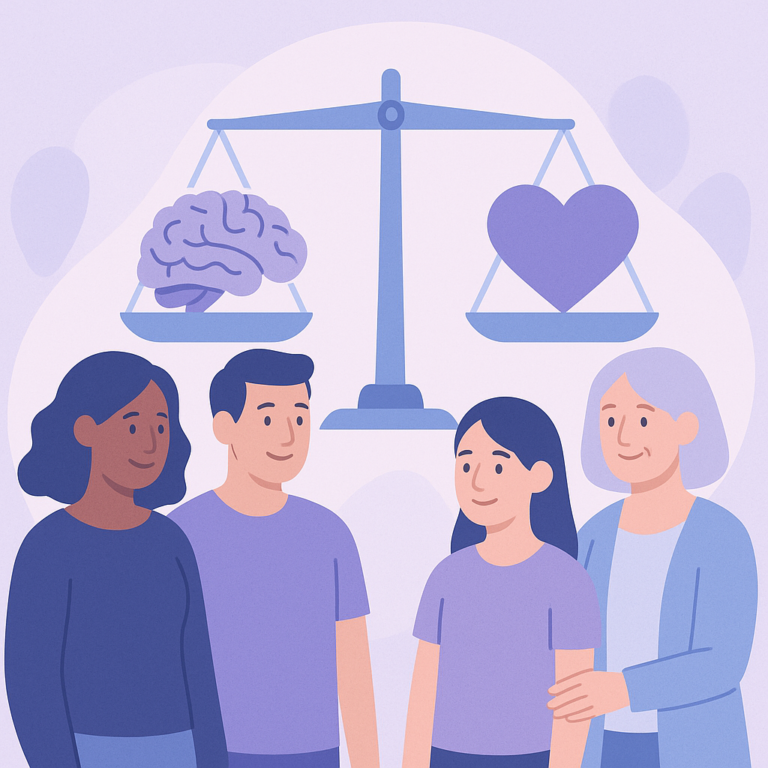
For families, this review suggests that DBS is an emerging but not yet well-established treatment option for some children and adolescents whose seizures remain difficult to control with medication. It may be considered in specialized epilepsy care, but decisions are complex and should take into account not only seizure outcomes but also development, quality of life, and longer-term psychosocial outcomes.
This may matter most for families exploring advanced treatment options after standard treatments have not worked. The review supports careful, specialized evaluation rather than broad use in all children with epilepsy.
What to watch next
Important next steps include coordinated multicenter efforts, network-informed target selection, comparisons with responsive stimulation approaches, and long-term studies that track seizure control, safety, neurodevelopment, and psychosocial outcomes as children grow.
Terms in this summary
- deep brain stimulation (DBS)
- A treatment that uses implanted wires and a device to send electrical signals to specific brain areas.
- drug-resistant epilepsy
- Epilepsy in which seizures continue despite trying appropriate seizure medicines.
- neuromodulation
- Treatment that changes nerve activity, often with electrical stimulation.
- thalamic
- Related to the thalamus, a deep brain structure involved in passing signals through the brain.
- limbic
- Related to brain areas involved in emotion, memory, and some seizure networks.
- off-label
- Use of a treatment in a way that is not specifically approved on the official label.
- connectome
- The map of how different parts of the brain are connected and communicate.
Free: Seizure First Aid Quick Guide (PDF)
Plus one plain-language weekly digest of new epilepsy research.
Unsubscribe anytime. No medical advice.