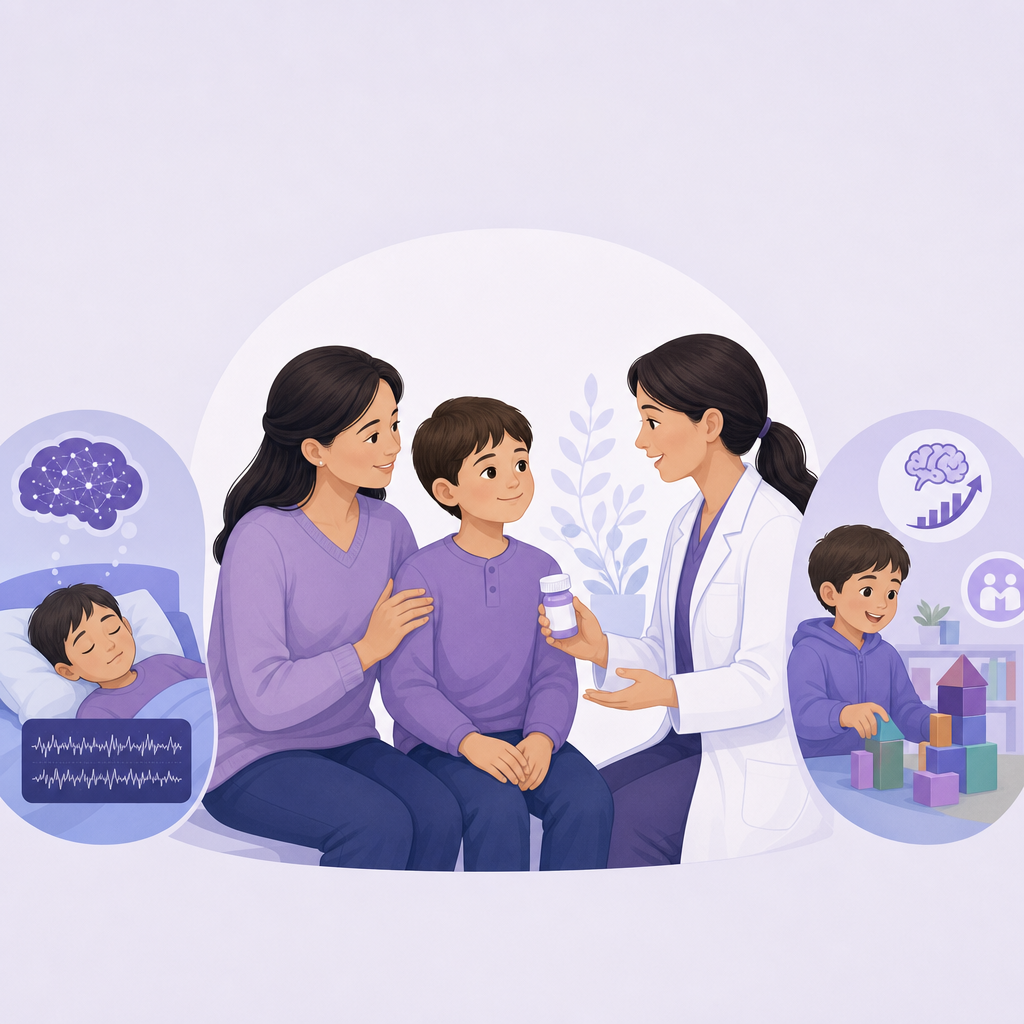
Ethosuximide May Improve Seizures, EEG, And Behavior
Source: Seizure
Summary
What was studied
This study looked at adding ethosuximide, a seizure medicine, to treatment for children with developmental and epileptic encephalopathy with spike-wave activation in sleep (D/EE-SWAS). It was a prospective observational study at one pediatric neurology center, meaning the researchers followed children over time but did not randomly assign treatment.
The study included 39 children ages 4 to 18. About 56% had a structural cause for their condition and 44% had an idiopathic cause, meaning no clear structural cause was identified. The researchers assessed seizures, EEG changes based on spike-wave index, parent-reported language and cognition, behavioral scores, and side effects after treatment.
What they found
After a median of 14 months on add-on ethosuximide, 28 of 39 children (71.8%) were seizure-free, and 33 of 39 (84.6%) had a favorable seizure outcome. EEG improvement occurred in 29 of 39 children (74.4%), and 8 of 39 (20.5%) had complete EEG normalization. Complete EEG normalization was more common in children with idiopathic D/EE-SWAS than in those with structural causes.
Parents reported improvement in language in 69.2% of children and in cognition in 64.1%. Behavioral scores also improved across several areas, including emotional symptoms, hyperactivity, conduct problems, peer problems, impact, and overall difficulties.
Side effects occurred in 28% of children and were mostly mild to moderate. One child developed a serious drug reaction called DRESS.
Limits of the evidence
This was not a randomized or controlled trial, so it cannot show that ethosuximide alone led to the improvements. Some children may have improved for other reasons, including other treatments, the natural course of the condition, or differences between patients.
The study was small, with 39 children, and it was done at a single center, so the results may not apply to all children with D/EE-SWAS. Some outcomes, such as language and cognition, were based on parent report rather than formal testing. The abstract also does not give full details about other medicines the children were taking.
For families and caregivers
This study suggests that add-on ethosuximide was associated with improvements in seizures, EEG findings, and behavior in some children with D/EE-SWAS. It also suggests that children without a structural brain cause may be more likely to have full EEG normalization.
At the same time, the evidence is still limited. Because this was not a controlled study, families should see these results as encouraging but not definitive. The serious reaction reported in one child also shows why careful medical follow-up matters.
What to watch next
Larger controlled studies are needed to better define the role of ethosuximide in treatment for D/EE-SWAS and could compare it with other treatment options and use formal language and cognitive testing.
Terms in this summary
- D/EE-SWAS
- A childhood epilepsy-related brain condition where frequent spike-wave activity during sleep can affect seizures, learning, language, and behavior.
- EEG
- A test that records the brain's electrical activity.
- spike-wave index
- A measure of how much spike-wave activity appears on the EEG during sleep.
- idiopathic
- A condition without a clear known structural cause.
- structural etiology
- A condition linked to a brain abnormality or injury that can be seen or identified.
- observational study
- A study where researchers watch what happens with treatment but do not randomly assign people to different groups.
- median
- The middle value in a list of numbers.
- DRESS
- A rare but serious drug reaction that can cause rash, fever, and problems in organs such as the liver.
Free: Seizure First Aid Quick Guide (PDF)
Plus one plain-language weekly digest of new epilepsy research.
Unsubscribe anytime. No medical advice.