Understanding your tests
EEG for Epilepsy: What to Expect and What Results Mean
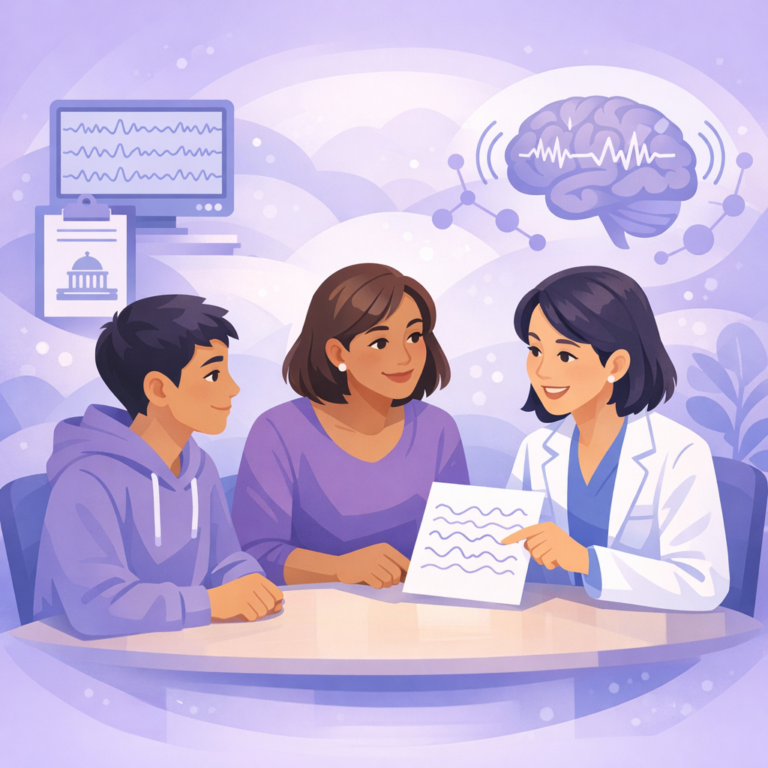
An EEG, short for electroencephalogram, records the brain's electrical activity. Small sensors on the scalp pick up signals; they do not put electricity into the brain. This guide helps adults and families prepare for the test and talk through the results.
Free guide · No signup required
Choose a useful starting point
Know what to expect
Understand the recording and why different types of EEG are used.
Prepare with confidence
Get the testing service’s instructions and plan for comfort and support.
Make sense of results
Learn what normal or abnormal findings can and cannot tell you.
On this page
The result is one part of the picture
A normal EEG does not rule out epilepsy. An abnormal result does not automatically establish a diagnosis either. Your care team considers the recording together with what happened, your medical history, and other tests.
What happens during an EEG?
A technologist attaches sensors with paste or a cap and records the signals on a computer. Many tests also record video. You may be asked to rest, open and close your eyes, or follow other instructions. Tell the team about any concerns before testing starts.
The recording itself is generally painless. Allow time for attaching and removing the sensors as well as the recording. Ask the testing service how long your appointment will take and when you will hear the results.
Why there are different EEG tests
Routine EEG
A shorter recording samples brain activity during a visit. It may show helpful patterns even when no seizure occurs, but it can miss changes that happen at other times.
Ambulatory EEG
A portable recorder collects signals over a longer period, often at home. You may be asked to record symptoms or press an event button so the team can match what happened to the recording.
Video EEG
Video and EEG together help the team compare an event with the brain signals. It can be done in different settings, including a hospital monitoring unit. Ask which question the recommended test is meant to answer.
Invasive EEG, such as stereo-EEG, is a different, specialized procedure used in some epilepsy surgery evaluations. A routine scalp EEG does not mean you will need invasive testing.
How to prepare
- Ask the testing service for its written instructions about hair products, meals, medicines, and sleep.
- Confirm the type of EEG, the appointment length, and whether someone should come with you.
- Ask how the team can support comfort, communication, sensory needs, or a child’s worries.
- Bring a medicine list and a brief description of the events being investigated.
- Make a plan for receiving and discussing the results.
Follow the testing team's instructions
Do not stop medicines or change your sleep to try to trigger a seizure on your own. Some EEG tests involve carefully planned changes or procedures; ask the ordering clinician and testing service exactly what applies to your test.
Understanding the results
If the EEG is normal: it only describes what was recorded during that test. Seizure-related changes may not appear in that sample. A normal result does not prove that a reported event was not a seizure.
If the EEG is abnormal: ask which pattern was found and how it fits your symptoms. Some patterns suggest a tendency to have seizures; other changes can occur for different reasons. The word “abnormal” alone does not explain the cause or the next step.
The result may help the clinician decide whether more testing is useful. It cannot, by itself, settle every question about diagnosis, treatment, or future seizures.
Questions for the care team
- What question are we trying to answer with this EEG?
- Why is this type of recording the best starting point?
- What preparation instructions apply to my medicines and sleep?
- What did the result show, and what does it leave uncertain?
- If the EEG is normal, what would make another test useful?
- What changes, if anything, in the plan after this result?
A common worry
Words you may hear
Electrode: a sensor used to record the signal.
Epileptiform discharge: a pattern that can suggest a tendency toward seizures, interpreted in clinical context.
Biomarker: a measurable clue studied for diagnosis or treatment decisions. A promising research marker may still need validation.
Optional: explore EEG research
Start with the explanations above if you are preparing for a test. These selected summaries describe particular research papers; new patterns or computer tools may still be experimental.
Sources and page information
Patient education and test explanations; checked October 5, 2026. Linked research summaries describe their own source papers.
Published by Epilepsy Explained. Suggest a correction: include the page URL, the passage, and a supporting source. How we prepare and correct our pages.