Eyelid Myoclonia Epilepsy: How Features May Change Over Time
This explainer reviews what a pediatric study found about eyelid myoclonia epilepsy over time.
Source: Epileptic disorders : international epilepsy journal with videotape
Summary
What was studied
Researchers reviewed records from 27 children with epilepsy with eyelid myoclonia who were followed between April 2020 and March 2026. This is a childhood-onset generalized epilepsy syndrome involving eyelid myoclonia.
The study examined how seizures changed over time, when eyelid myoclonia was recognized, repeated EEG findings, brain imaging information, and responses to antiseizure medicines.
What they found
Eyelid myoclonia was recognized at presentation in 14 children and only during later follow-up in 13. The complete classical clinical and EEG pattern was present at onset in only 4 of 27 children.
Ten children initially had eyelid myoclonia without other seizure types. Six later developed additional seizure types, while four continued to have only eyelid myoclonia. An abnormal EEG response to flashing light was documented in 5 children, and focal epileptiform discharges were seen in 4.
Of 21 seizure-free children, 10 still had epileptiform abnormalities on EEG. Many children treated with lamotrigine had favorable seizure outcomes, although the abstract does not report an exact number or establish comparative treatment efficacy.
Limits of the evidence
This was a retrospective review of 27 children rather than a controlled treatment trial. The patterns described over time were summaries and were not predefined or validated disease subtypes. The abstract does not provide patient ages, individual follow-up durations, detailed imaging results, medicine doses, or direct treatment comparisons. The study therefore cannot determine whether lamotrigine is more effective than other medicines or whether it caused the favorable outcomes.
For families and caregivers
This epilepsy syndrome may not show all of its classical clinical and EEG features at first. Eyelid myoclonia can initially be missed, and the absence of photosensitivity or classical reflex EEG findings does not necessarily rule out the diagnosis when the clinical pattern is suggestive. Repeated clinical and EEG assessment may help clarify the pattern over time. Epileptiform EEG abnormalities can also continue despite seizure freedom, so EEG findings should be interpreted together with the child's broader clinical course.
What to watch next
Prospective studies and direct treatment comparisons are needed to clarify clinical patterns over time and compare treatment effectiveness.
Terms in this summary
- eyelid myoclonia
- Brief jerking movements of the eyelids associated with this epilepsy syndrome.
- generalized epilepsy
- Epilepsy in which seizure activity appears to involve networks on both sides of the brain from the start.
- EEG
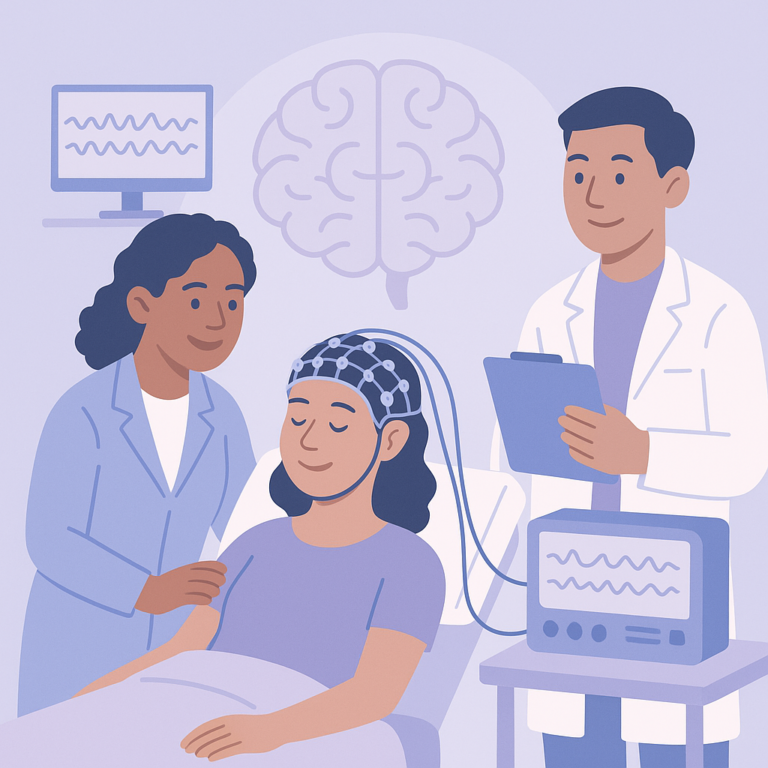
- Electroencephalogram, a test that records the brain's electrical activity using sensors placed on the scalp.
- eye-closure sensitivity
- A tendency for closing the eyes to trigger seizure-related EEG changes or seizures.
- photosensitivity
- A tendency for flashing or flickering light to trigger seizure-related EEG changes or seizures.
- photoparoxysmal response
- An abnormal epileptiform EEG response during flashing-light testing.
- focal epileptiform discharges
- Brief abnormal EEG signals that appear to arise from one area of the brain.
- lamotrigine
- An antiseizure medicine used to treat several types of epilepsy.
PubMed abstract used to verify this summary
Free: Seizure First Aid Quick Guide (PDF)
Plus one plain-language weekly digest of new epilepsy research.
Unsubscribe anytime. No medical advice.