EEG After Stroke: What the Research Review Found
This explainer summarizes what the review reported about EEG after stroke.
Source: ScienceDirect
Summary
What was studied
This was a review of available research on the use of electroencephalography (EEG) in adults during acute stroke care and later recovery. It did not report a new trial or a specific group of participants.
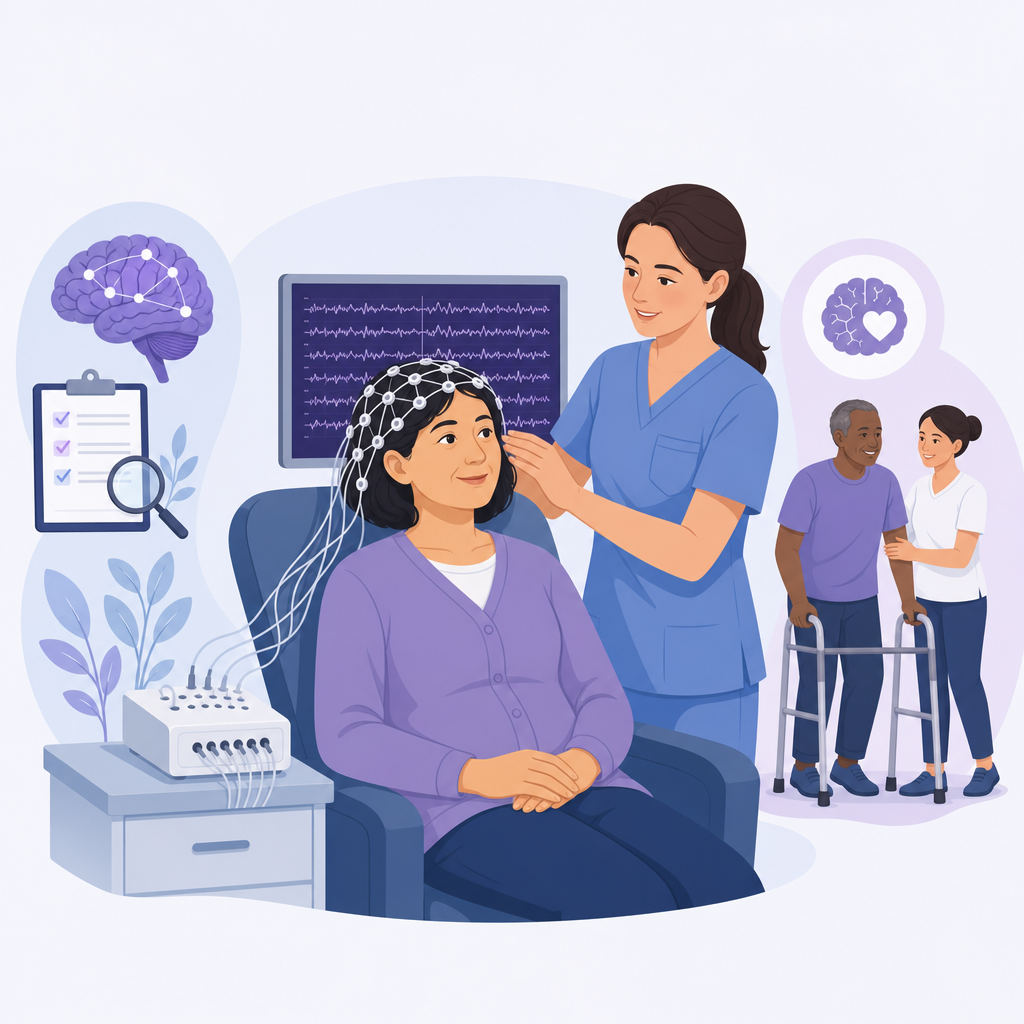
The review considered routine EEG, continuous EEG, and computer-analyzed quantitative EEG. It examined their possible roles in detecting seizures, estimating recovery, identifying people at risk of post-stroke epilepsy, and supporting long-term management decisions.
What they found
During acute stroke care, EEG can detect seizures without obvious convulsions and status epilepticus, especially in people with impaired consciousness. Certain abnormal EEG patterns were associated with adverse outcomes and a higher risk of acute seizures. Quantitative EEG measures may help identify emerging ischemia and contribute to estimates of functional recovery.
Later after a stroke, EEG may help identify people at increased risk of post-stroke epilepsy when used alongside validated risk scores. Repeated EEG testing may also detect subclinical epileptic activity, track recovery, and help guide antiseizure medication adjustments. However, the abstract does not establish that EEG-guided interventions improve patient outcomes.
Limits of the evidence
The evidence came from studies that differed in their methods, patient groups, and EEG protocols. Standardized strategies for using EEG throughout stroke care are lacking, and evidence for EEG-guided interventions is limited. Outcome-related data are limited, and some groups were underrepresented. The abstract does not give the number, size, or quality of the studies reviewed, so the overall strength of the evidence cannot be fully assessed.
For families and caregivers
EEG may provide useful information when a person with stroke has unexplained reduced awareness or is suspected of having seizures without visible convulsions. It may also help clinicians estimate the risk of later epilepsy. However, EEG is one part of the assessment, and the evidence that EEG-guided treatment improves outcomes remains limited.
What to watch next
Multicenter trials using standardized EEG methods are needed to validate proposed EEG biomarkers and determine whether EEG-guided stroke care improves outcomes and is cost-effective.
Terms in this summary
- electroencephalography (EEG)
- A test that records the brain's electrical activity using sensors placed on the scalp.
- continuous EEG (cEEG)
- EEG recording performed for an extended period, often for many hours or days.
- nonconvulsive seizure
- A seizure that occurs without obvious convulsions or major shaking.
- status epilepticus
- Prolonged or repeatedly occurring seizure activity that requires urgent medical attention.
- epileptiform abnormalities
- EEG patterns associated with an increased tendency or risk of seizures.
- quantitative EEG (QEEG)
- Computer-based analysis that summarizes or measures features of EEG activity.
- post-stroke epilepsy
- Epilepsy that develops after a stroke.
- antiseizure medications (ASMs)
- Medicines used to prevent or control seizures.
PubMed abstract used to verify this summary
Free: Seizure First Aid Quick Guide (PDF)
Plus one plain-language weekly digest of new epilepsy research.
Unsubscribe anytime. No medical advice.