Pediatric Seizure Testing After New Seizure-Like Events: What One Clinic Study Found
This explainer reviews pediatric seizure testing in a retrospective study of 1,213 children seen at one specialized first seizure clinic.
Source: Epileptic disorders : international epilepsy journal with videotape
Summary
What was studied
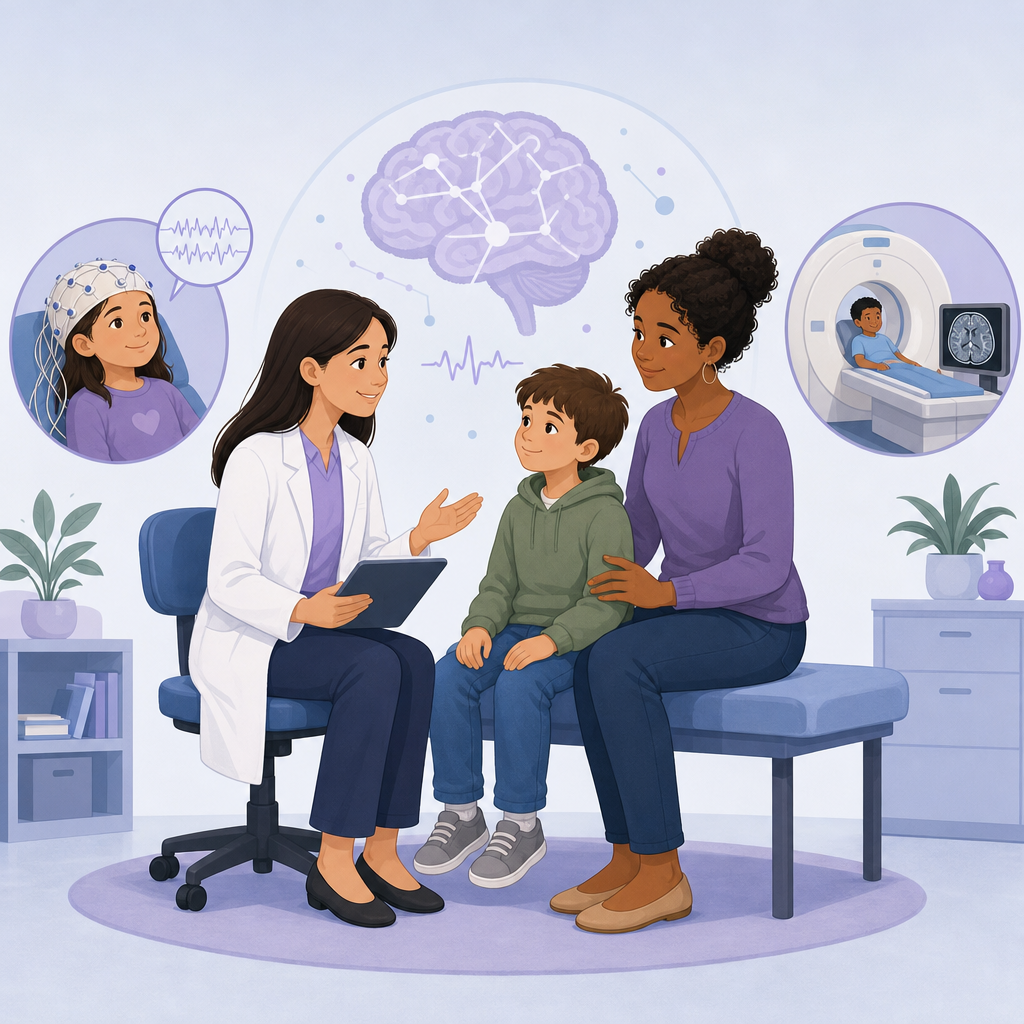
Researchers reviewed medical records of 1,213 children seen at a specialized first seizure clinic for new seizure-like events. This was a retrospective cohort study, meaning it looked back at care that had already taken place. Every child had a routine EEG as part of the first clinic assessment.
The study examined how additional tests performed after that visit—including repeat EEG, MRI, and genetic testing—helped establish a final diagnosis of epilepsy or no epilepsy.
What they found
At the first clinic visit, 23.0% of children were diagnosed with epilepsy, 43.4% with no epilepsy, and 33.6% had an undefined diagnosis. The undefined group included children with a single unprovoked seizure (5.9%) and those whose events were unclear (27.8%). At follow-up, 33.6% had an epilepsy diagnosis, 60.8% had no epilepsy, and 5.7% remained unclear.
Only 23 children (1.9% of all children, or 2.9% of those with a definite initial diagnosis) were initially misclassified. Additional testing was mainly used for children whose initial diagnosis was undefined.
Among the 934 children not initially diagnosed with epilepsy, repeat EEG contributed to a final epilepsy diagnosis in 7.7%, MRI in 1.2%, and genetic testing in 0.4%. Sleep-deprived EEG was the most commonly performed type of repeat EEG. It showed epilepsy-related electrical discharges between seizures in up to 71.2% of children whose initial diagnosis was unclear and whose final diagnosis was epilepsy.
Limits of the evidence
This study looked back at records from one specialized clinic, so its findings may not apply to all children or care settings. The abstract does not report the children's ages, the length of follow-up, or how many children received each additional test. The percentages for repeat EEG, MRI, and genetic testing describe their contribution across the 934 children without an initial epilepsy diagnosis; they are not the success rates among only those who received each test. The 71.2% result applies to a selected subgroup, not all children with seizure-like events. These findings do not establish which test is best for every child.
For families and caregivers
A new seizure-like event did not always lead to an epilepsy diagnosis: 60.8% of children were ultimately diagnosed with no epilepsy. An uncertain first assessment was also different from an incorrect diagnosis. For children whose diagnosis was initially undefined, repeat EEG—particularly sleep-deprived EEG—contributed to a final epilepsy diagnosis more often than MRI or genetic testing in this study.
What to watch next
Studies across several clinics that report follow-up length and exactly who received each test could help clarify when additional testing is most informative.
Terms in this summary
- Seizure-like event
- An episode that resembles a seizure but may or may not be caused by epilepsy.
- EEG
- A test that records the brain's electrical activity using sensors placed on the scalp.
- Sleep-deprived EEG
- An EEG performed after a person has had less sleep than usual.
- Interictal epileptiform discharges
- Electrical patterns recorded between seizures that can support an epilepsy diagnosis.
- MRI
- A scan that uses magnets and radio waves to make detailed pictures of the brain.
- Unprovoked seizure
- A seizure without an identified immediate trigger.
- Diagnostic yield
- How often a test provides information that helps establish a diagnosis.
PubMed abstract used to verify this summary
Suggest a correction · Editorial standards
Free: Seizure First Aid Quick Guide (PDF)
Plus one plain-language weekly digest of new epilepsy research.
Unsubscribe anytime. No medical advice.