Best EEG Analysis Methods For Seizure-Related Conditions
Source: NeuroImage
Summary
What was studied
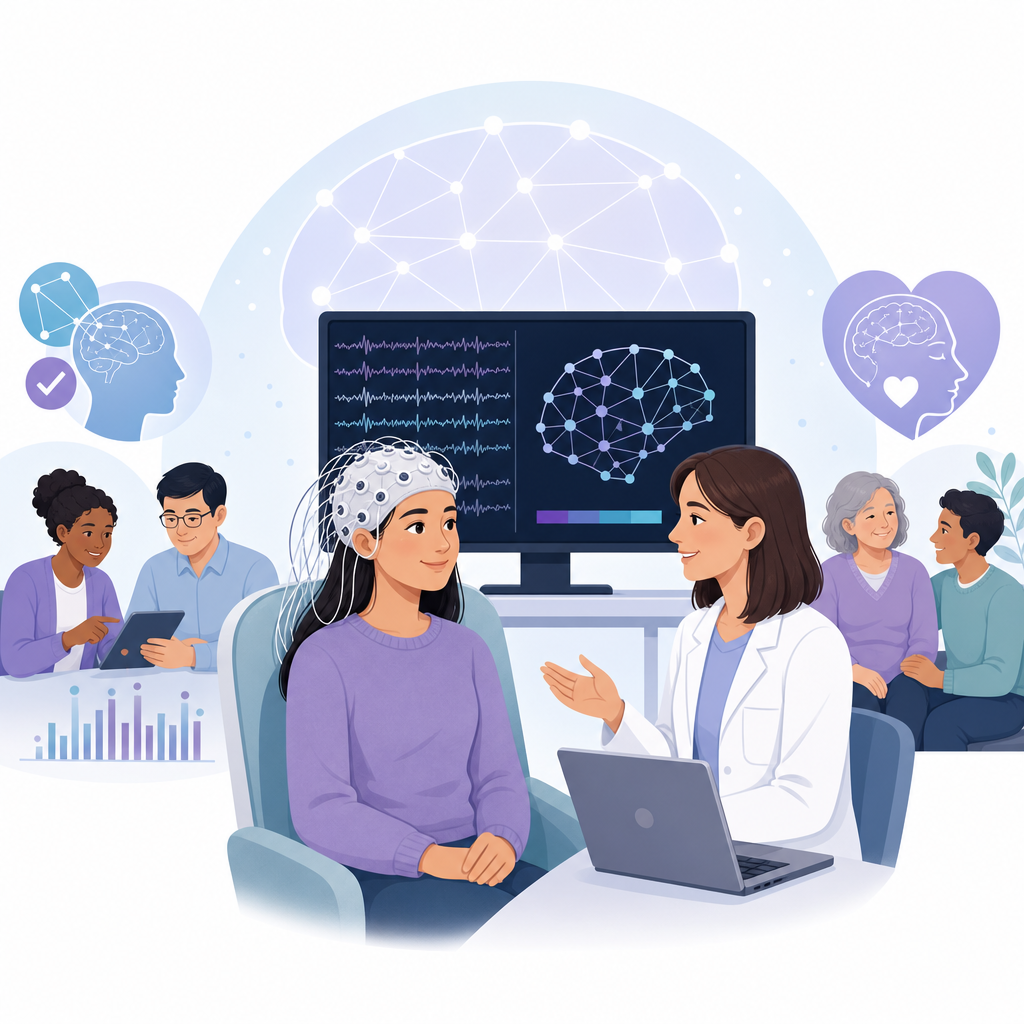
Researchers looked at how different ways of analyzing EEG "functional connectivity" perform in seizure-related conditions. Functional connectivity means estimating how brain signals from different EEG channels relate to each other. The goal was to see which analysis choices best separated patient groups.
They used past EEG recordings from two groups: 140 acutely ill adults, including 70 who had seizures and 70 who did not, and 32 children with self-limited focal epilepsy with centro-temporal spikes (SeLECTS), including 16 with cognitive regression and 16 without. The team evaluated 960 different EEG analysis pipelines in each group by changing things like EEG re-referencing, frequency band, connectivity measure, and network features.
What they found
In both the adult and child groups, significant EEG connectivity differences were observed between the sub-groups, and some analysis methods discriminated between the groups better than others. Methods that used corrected ways of measuring signal relationships, such as corrected correlation and weighted phase lag index, consistently showed superior performance. Network measures that describe integration and segregation, such as characteristic path length and clustering coefficient, also consistently showed superior performance.
The best-ranked analysis pipelines were not the same in the two disorders. This suggests that the choice of EEG connectivity method depends on the clinical context and is not one-size-fits-all. Overall, the study suggests EEG connectivity analysis has potential as a biomarker in seizure-related conditions, and that the exact method used matters a great deal.
Limits of the evidence
This was a retrospective study, so it looked back at existing EEG data rather than testing methods prospectively in real-time care. It compared how well pipelines separated groups, but it does not show that these methods improve diagnosis, predict outcomes, or should change treatment.
The child group was small, with only 32 patients. The study included only two specific seizure-related conditions, so the findings may not apply to all epilepsy types or all hospital patients. The abstract also does not give detailed accuracy numbers for each method, so it is hard to judge how large the performance differences were in practice.
For families and caregivers
For families, this study suggests that EEG may offer more information than just whether seizures or spikes are present. Looking at how different brain areas interact might someday help doctors better sort patients into meaningful groups.
At the same time, this is mainly a methods study. It helps researchers choose EEG analysis settings, but it does not yet show a direct benefit for an individual child or adult in clinic. Families can take this as a sign that EEG research is moving toward more precise tools, while recognizing that more validation is still needed before routine use.
What to watch next
Larger studies could test whether the best-performing EEG connectivity pipelines hold up in new patient groups and support automated EEG connectivity analysis in clinical practice.
Terms in this summary
- EEG
- A test that records the brain's electrical activity using sensors on the scalp.
- functional connectivity
- An estimate of how signals from different parts of the brain change together over time.
- pipeline
- The full set of analysis steps used to process and study EEG data.
- biomarker
- A measurable sign that may help identify a disease, risk, or outcome.
- weighted phase lag index
- An EEG measure that estimates how brain signals are linked while trying to reduce false links caused by shared noise or volume conduction.
- characteristic path length
- A network measure related to how easily information may travel across a brain network.
- clustering coefficient
- A network measure showing how strongly nearby parts of a network group together.
- retrospective study
- A study that uses data already collected in the past.
Free: Seizure First Aid Quick Guide (PDF)
Plus one plain-language weekly digest of new epilepsy research.
Unsubscribe anytime. No medical advice.