Brain Signal Changes May Predict Better Epilepsy Relief
Source: Epilepsia
Summary
What was studied
This study looked at whether a brain signal called slow gamma activity in the anterior nucleus of the thalamus (ANT) might help indicate whether deep brain stimulation (DBS) is working for people with drug-resistant epilepsy.
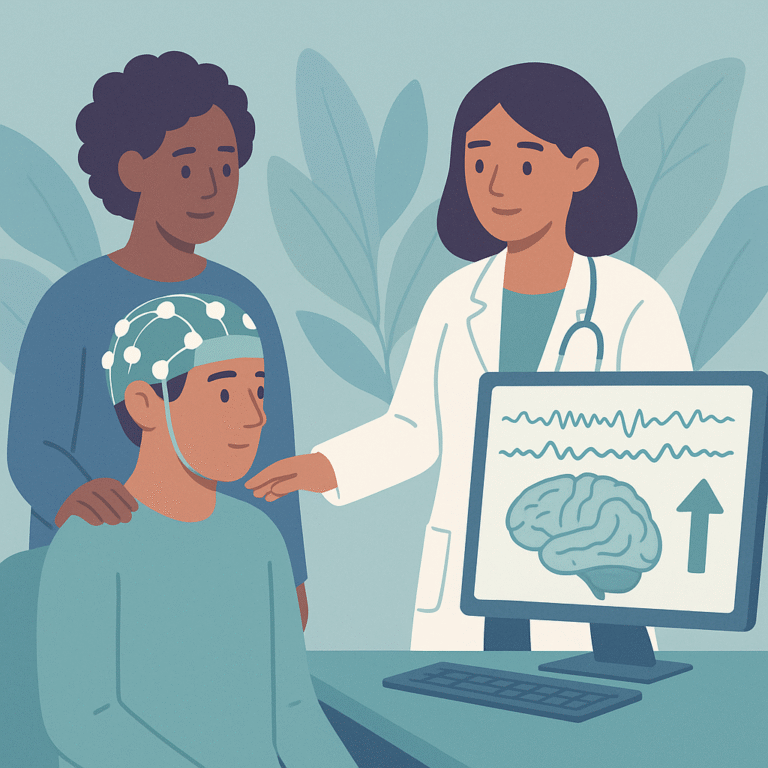
The researchers retrospectively analyzed 11 people who were already enrolled in an ongoing ANT-DBS parameter optimization trial. During clinic visits, the DBS device recorded short samples of brain activity at baseline and during stimulation while different stimulation settings were tested around the SANTE trial clinical setting. The team also used seizure diaries to classify people as "responders" if seizures dropped by more than 50% compared with before DBS.
What they found
Among the 11 participants, 7 showed slow gamma oscillations in the ANT recordings. Of those 7, 6 were responders. In 5 of those 6 responders, slow gamma activity became progressively more suppressed over time during chronic stimulation, and this correlated with greater long-term seizure reduction. During short in-clinic testing, stimulation suppressed slow gamma activity in 4 of 5 responders who were tested with multiple settings. The authors suggest that suppression of this signal may be a potential biomarker to help identify responders, track treatment over time, and guide DBS setting adjustments.
Limits of the evidence
This was a small study with only 11 participants, and only 7 had the slow gamma signal the researchers were studying. The analysis was retrospective, so it cannot show from this study alone that gamma suppression leads to seizure improvement. Seizure outcomes were based on seizure diaries, which can be incomplete. The abstract also provides limited information about how this marker performed in non-responders or in broader groups of patients, so it is not yet clear how reliable it would be in routine care.
For families and caregivers
For families, this study suggests there may someday be a faster way to help judge whether thalamic DBS is helping and whether the settings should be adjusted, instead of waiting months to assess benefit by seizure counts alone. The abstract also notes that clinicians currently lack real-time biomarkers when choosing stimulation parameters.
Still, this is early evidence from a very small group. It does not mean this brain signal is ready to guide treatment on its own, and it does not show that one DBS setting works best for everyone.
What to watch next
Stronger evidence would come from larger prospective studies showing whether using this gamma signal to adjust DBS settings is practical and is associated with better seizure outcomes than standard programming.
Terms in this summary
- drug-resistant epilepsy
- Epilepsy that does not improve enough after trying standard seizure medicines.
- deep brain stimulation (DBS)
- A treatment that sends electrical pulses to specific brain areas through implanted wires.
- anterior nucleus of the thalamus (ANT)
- A part of the thalamus, deep in the brain, that can be targeted with DBS for epilepsy.
- local field potential (LFP)
- A recording of electrical activity from groups of brain cells near the implanted electrode.
- slow gamma oscillations
- A pattern of brain activity in the 20 to 50 hertz range.
- biomarker
- A measurable sign that may help show whether a disease or treatment is changing.
- responder
- In this study, a person whose seizure frequency dropped by more than 50% after DBS.
- parameter titration
- Adjusting treatment settings, such as DBS pulse settings, to try to get the best effect.
Free: Seizure First Aid Quick Guide (PDF)
Plus one plain-language weekly digest of new epilepsy research.
Unsubscribe anytime. No medical advice.