Tool Helps Spot Common Childhood Epilepsy From EEG Reports
Source: Medicine
Summary
What was studied
Researchers developed and tested a computer model to help identify self-limited epilepsy with centrotemporal spikes (SeLECTS), a common childhood epilepsy. Instead of using raw EEG signals, the model used information already written in structured EEG reports plus routine lab test results. The goal was to create a tool that could work across different hospitals, where EEG reading styles and testing methods may vary.
This was a retrospective multicenter study, meaning the researchers looked back at existing records. They used data from 1,067 patients for model development and internal validation, and then evaluated the model in a separate outside group of 94 patients for external validation. From 242 possible variables, they selected 13 key features, including age, where EEG discharges were located, whether spikes or spike-wave patterns were present, background rhythm, facial or limb clonus, and some lab measures such as lactate dehydrogenase, white blood cell differential, and vitamin D level.
What they found
Among 10 machine learning methods, the best-performing model was eXtreme Gradient Boosting. In internal validation, it showed strong ability to distinguish SeLECTS from non-SeLECTS cases, with an AUROC of 0.97, accuracy of 0.91, sensitivity of 0.83, and specificity of 0.94. In the external group, performance remained high: AUROC 0.96, accuracy 0.88, sensitivity 0.74, and specificity 0.94.
The external results were only slightly lower than the internal results. Calibration analyses indicated close agreement between predicted and observed risks, and decision curve analysis showed positive net benefit across low-to-moderate thresholds. The most important features highlighted by the explainability analysis included temporal discharges, age, central discharges, and lactate dehydrogenase.
Limits of the evidence
This study does not show that the model improves patient outcomes or should replace a clinician's judgment. It was retrospective, so it used past records rather than testing the tool prospectively in real-time care. The external validation group was small (94 patients), which limits confidence about how well the model will perform in other settings.
The model depended on structured EEG reports and available lab data, so results may differ in centers that document EEGs differently or do not collect the same tests. Some missing data were handled with multiple imputation, which can add uncertainty. Also, the abstract does not describe exactly who was in the comparison group, how diverse the patients were, or how the tool performs in different ages or clinical situations.
For families and caregivers
For families, this study suggests that a computer tool might help doctors flag children whose EEG reports and routine tests look like SeLECTS. Because it uses information already collected in usual care, it could fit into workflow more easily than tools that need raw EEG files.
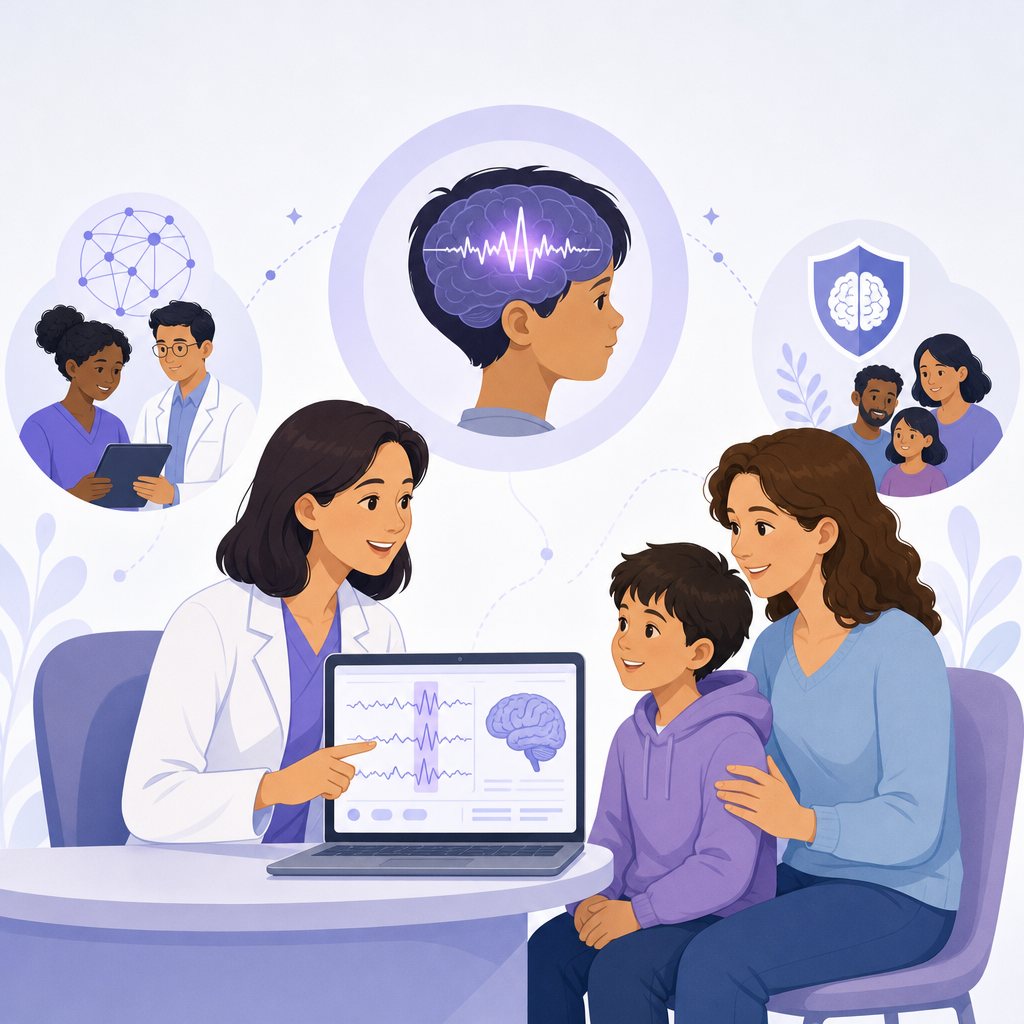
The model was designed as a "second-view" aid after EEG reporting, with possible use for risk alerts, quality checks, or deciding which cases need closer review. But it is not a diagnosis by itself, and the study does not show that using the tool changes treatment or improves seizure control.
What to watch next
Stronger evidence would come from larger prospective studies in multiple hospitals showing how the tool performs in real-time care and whether it helps clinicians in practice.
Terms in this summary
- SeLECTS
- A common childhood epilepsy syndrome, also called self-limited epilepsy with centrotemporal spikes.
- EEG
- A test that records the brain's electrical activity.
- machine learning
- A computer method that finds patterns in data to make predictions.
- AUROC
- A measure of how well a model separates one group from another; closer to 1.0 is better.
- sensitivity
- How often a test correctly identifies people who have the condition.
- specificity
- How often a test correctly identifies people who do not have the condition.
- calibration
- How closely a model's predicted risks match what really happens.
- external validation
- Testing a model on data from a different group or hospital than the one used to build it.
Free: Seizure First Aid Quick Guide (PDF)
Plus one plain-language weekly digest of new epilepsy research.
Unsubscribe anytime. No medical advice.