AI Tool Helps Detect Seizures Quickly And Accurately
Source: Brain informatics
Summary
What was studied
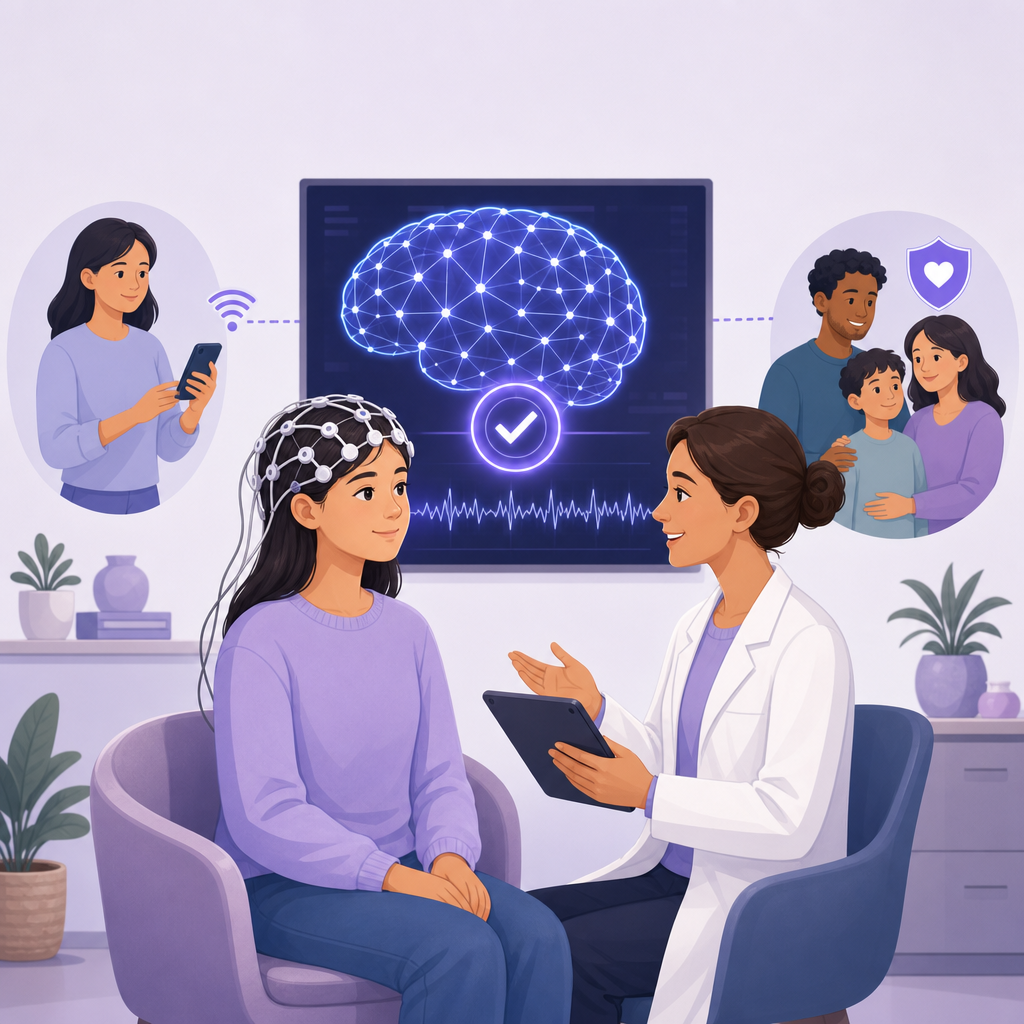
This study developed and tested a computer model called EffiFormer to detect epileptic seizures from EEG recordings. The model combines two kinds of image-analysis methods: a CNN and a vision transformer. Instead of reading the EEG signal directly, the researchers turned EEG data into spectrograms, which are picture-like displays of how brain-wave frequencies change over time.
The study used the public CHB-MIT dataset, which contains long-term scalp EEG recordings from 22 pediatric patients at Children's Hospital Boston. The researchers split the data into training, validation, and test sets in a 60-20-20 ratio. Their pipeline also included signal normalization, Short-Time Fourier Transform to make spectrograms, synthetic seizure sample generation with SMOTE, and data augmentation. They also used explainable AI methods to highlight which EEG regions most influenced the model's decisions.
What they found
In this dataset, the model reported very high performance, with average sensitivity of 99.8% and average accuracy of 99.3%. In simple terms, it detected most seizure events and correctly classified EEG segments very often.
The authors describe the model as performing well even with limited training data by combining spatial feature extraction from EfficientNet with global attention mechanisms from a data-efficient vision transformer. The explainable AI step was used to make the model more transparent by showing which EEG regions influenced its predictions.
Limits of the evidence
This was a model-development study using one public dataset. The results show how the system performed on this dataset, but the abstract does not show how well it would work in other settings or patient groups.
The dataset included 22 pediatric patients, so it is unclear from the abstract how well the model would apply to adults, different EEG setups, or broader clinical populations.
The abstract also does not provide details about false alarms, seizure types, timing of detection, or comparisons with other detection methods.
For families and caregivers
This study suggests that AI tools may help detect seizures from EEG recordings with high performance in a research dataset. If similar results are seen in broader clinical testing, such systems could support faster review and response.
For families, the main takeaway is that this is promising technical research based on a public pediatric EEG dataset. The added explainability may also help clinicians review why the system flagged a possible seizure.
What to watch next
Important next steps would include testing the model in larger and more diverse groups and reporting additional practical measures such as false alarms, missed seizures, and performance in real clinical settings.
Terms in this summary
- EEG
- A test that records the brain's electrical activity using sensors placed on the scalp.
- spectrogram
- A visual display that shows how signal frequencies change over time.
- CNN
- A type of artificial intelligence model that is good at finding patterns in images.
- vision transformer
- An artificial intelligence model that uses attention methods to analyze image information more broadly.
- sensitivity
- How often a test correctly finds true seizure events when they are present.
- accuracy
- How often a test gives the correct result overall.
- Short-Time Fourier Transform
- A method used to turn a signal like EEG into a time-and-frequency picture.
- SMOTE
- A technique that creates synthetic examples to help balance datasets when one class, such as seizures, is less common.
Free: Seizure First Aid Quick Guide (PDF)
Plus one plain-language weekly digest of new epilepsy research.
Unsubscribe anytime. No medical advice.