MEG in Pediatric Epilepsy: Uses, Limits, and Research Context
This explainer reviews what the article says about MEG in pediatric epilepsy and its potential clinical uses.
Source: Annals of the Child Neurology Society
Summary
What was studied
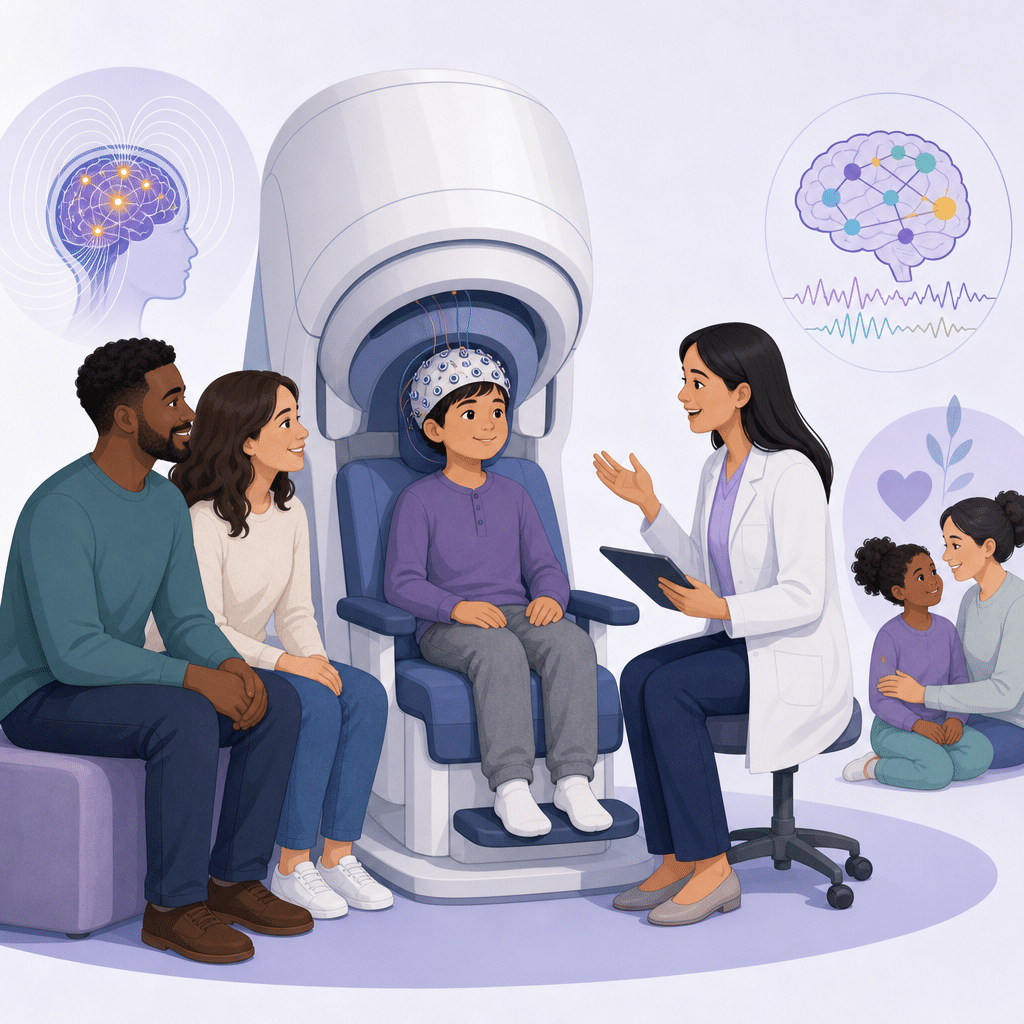
This article reviewed magnetoencephalography (MEG) in pediatric and adult epilepsy and provided illustrative cases showing its use. MEG records magnetic fields produced by electrical currents in the brain.
The review discussed using MEG to locate epileptogenic zones, determine which side of the brain supports language, map the sensorimotor cortex, and identify visually evoked fields. The abstract does not report the number, ages, or clinical details of the people in the illustrative cases.
What they found
The authors describe MEG as a powerful tool with key advantages in pediatric epilepsy. It can help locate seizure-related brain areas and map language, sensorimotor, and visual functions. The abstract states that most current limitations are resource driven and suggests that MEG may become more prominent in pediatric epilepsy and epilepsy surgery as technology advances.
Limits of the evidence
This is a review with illustrative cases, not a controlled study testing whether MEG improves seizure control, surgical outcomes, or safety. The abstract provides no sample size, comparison group, numerical results, accuracy measures, or details about specific resource barriers. It therefore does not establish how much MEG adds compared with other tests or which patients are most likely to benefit.
For families and caregivers
MEG is a brain-mapping technology that may help a clinical team locate areas linked to seizures and identify regions involved in language, movement, sensation, and visual responses. It may be used when evaluating pediatric epilepsy or epilepsy surgery. This abstract does not show that MEG alone can identify the source of seizures or predict whether surgery will be successful.
What to watch next
Further research could compare MEG with other brain-mapping methods and examine whether its use improves surgical planning or long-term outcomes in children with epilepsy.
Terms in this summary
- Magnetoencephalography (MEG)
- A technology that records magnetic fields produced by electrical currents in the brain.
- Epileptogenic zone
- The brain area or areas associated with generating seizures.
- Lateralize
- To determine whether a function or abnormal activity is mainly on the left or right side of the brain.
- Sensorimotor cortex
- Brain areas involved in movement and sensory functions.
- Visually evoked fields
- Magnetic brain responses produced by visual stimulation.
- Epilepsy surgery
- Surgery used as a treatment approach for some people with epilepsy.
Free: Seizure First Aid Quick Guide (PDF)
Plus one plain-language weekly digest of new epilepsy research.
Unsubscribe anytime. No medical advice.