How Brain Targeting for Epilepsy Surgery Has Improved
Source: Journal of neurosurgery
Summary
What was studied
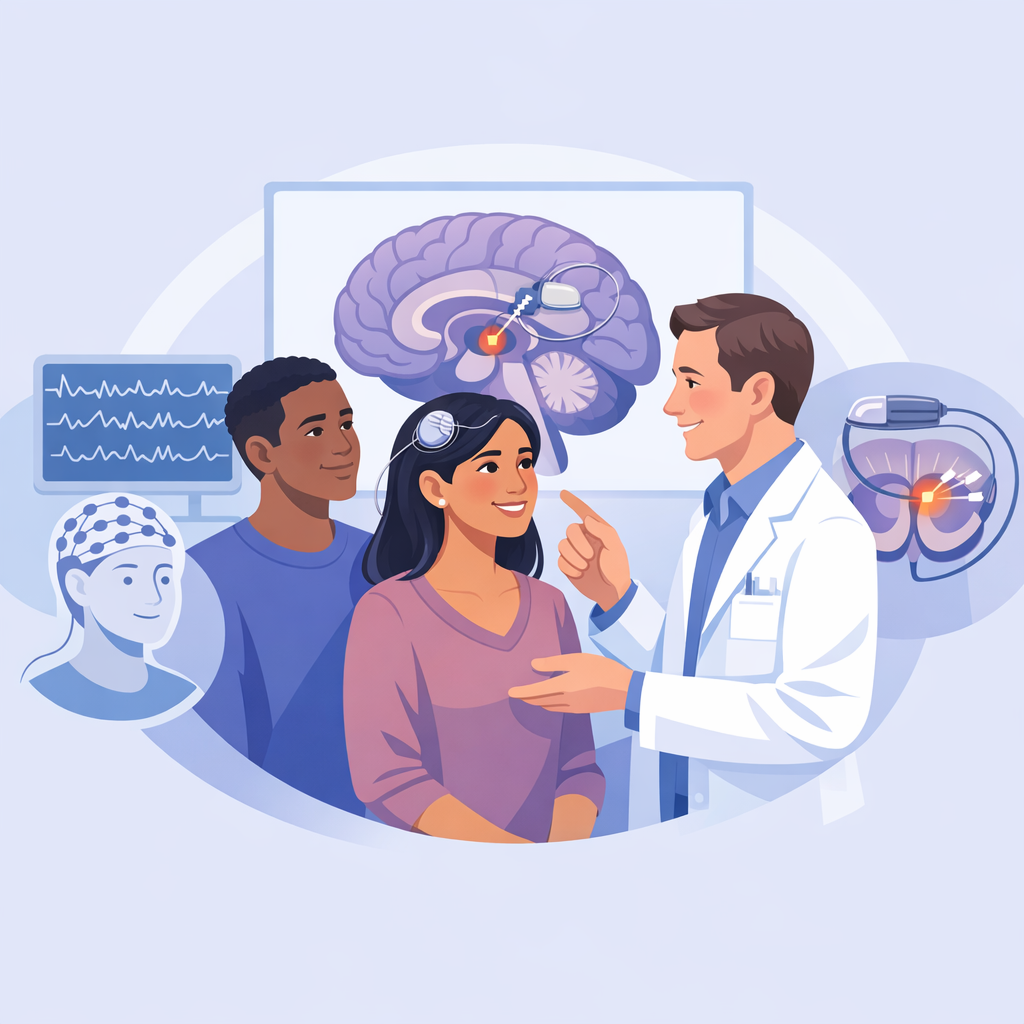
This paper is a review, not a report of new patient results. It examines how doctors target the centromedian nucleus (CM), a part of the thalamus, when placing brain stimulation electrodes for epilepsy, especially idiopathic generalized epilepsy.
The review focuses on the surgical targeting methods used in the NAUTILUS trial, a multicenter, randomized, sham-controlled study of CM stimulation. The abstract says the trial has finished, but the treatment results were not yet available at the time of this paper. The authors describe how targeting has changed over time, from older coordinate-based methods to newer MRI-guided and atlas-informed methods used across NAUTILUS sites.
What they found
The main point is that precise electrode placement in the CM is presented as important for engaging the intended thalamocortical circuits and for reproducibility across centers. The review describes newer targeting methods that use advanced MRI sequences and atlas-informed planning to individualize placement, and these methods were implemented across NAUTILUS centers. The authors state that this workflow enabled accurate electrode placement even in patients with complex anatomy, and that atlas-based alternatives can be used when imaging quality is suboptimal.
Limits of the evidence
This abstract does not provide patient outcome data, seizure results, side effects, or long-term follow-up. Because this is a review and methods paper, it cannot show that the newer targeting approach improves seizures or quality of life. The abstract also does not say how many patients were involved in the NAUTILUS trial or how different targeting methods compare head-to-head.
For families and caregivers
For families, this paper matters because it explains how doctors aim to place stimulation electrodes more precisely for epilepsy treatment. For context on devices and other procedures, see how stimulation fits among epilepsy surgery options. More standardized targeting may make future studies easier to compare and may help researchers study whether electrode location relates to outcomes. But this paper does not show that CM stimulation works better yet; it mainly describes a standardized surgical framework.
What to watch next
Important next evidence will come when the NAUTILUS trial reports seizure, safety, and quality-of-life results and examines how those outcomes relate to electrode location.
Terms in this summary
- neuromodulation
- Treatment that changes brain activity using electrical stimulation.
- idiopathic generalized epilepsy
- A type of epilepsy with seizures that involve both sides of the brain and do not have a clear structural cause.
- centromedian nucleus (CM)
- A small area in the thalamus that is being studied as a target for brain stimulation in epilepsy.
- thalamocortical circuits
- Brain pathways connecting the thalamus and the outer part of the brain that are involved in brain signaling relevant to epilepsy.
- randomized, sham-controlled trial
- A study where people are assigned by chance to active treatment or to a comparison group that mimics treatment without delivering the real therapy.
- stereotactic
- Using a precise 3D method to guide surgery to a specific spot in the brain.
- atlas-based
- Using a detailed brain map to help find a target when direct imaging is limited.
Free: Seizure First Aid Quick Guide (PDF)
Plus one plain-language weekly digest of new epilepsy research.
Unsubscribe anytime. No medical advice.