Wearables Detect Most Convulsive Seizures But Miss Some Focal Ones
Source: Frontiers in bioengineering and biotechnology
Summary
What was studied
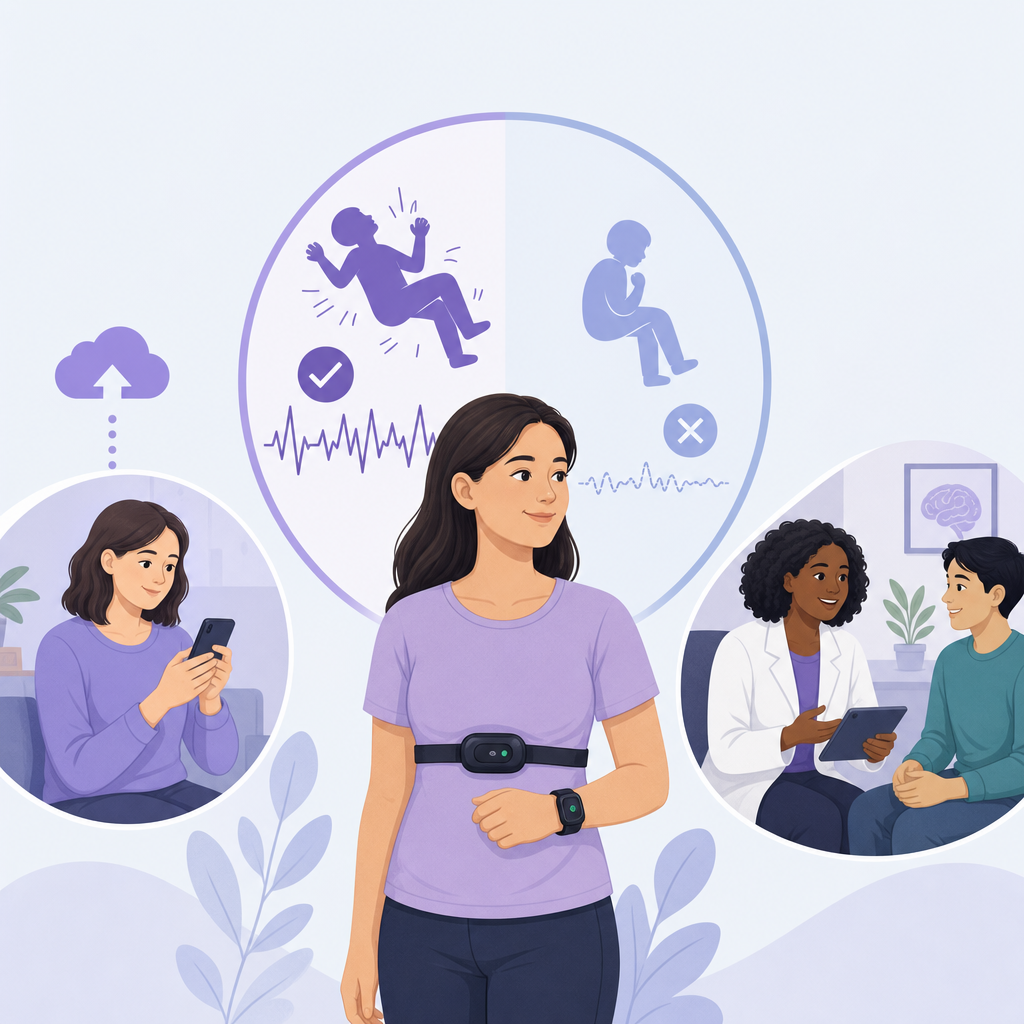
This paper reviewed and combined results from earlier studies on wearable devices that try to detect seizures. The devices were non-invasive, meaning they were worn on the body rather than implanted. They included wrist-worn and surface-worn sensors that measured movement, heart rate, and skin-related signals such as electrodermal activity.
The researchers included studies published through July 15, 2025. To judge whether a seizure was truly detected, the studies compared the wearable device results with video-EEG monitoring, which was the reference standard. The review included 31 studies of tonic-clonic seizures, covering 2,128 patients and 112,542 hours of monitoring, and 9 studies of focal seizures, covering 660 patients and 15,056 hours of monitoring.
What they found
For tonic-clonic seizures, wearable devices detected about 89.9% of seizures overall. On average, they also gave about 1.43 false alarms every 24 hours. Wrist-worn devices had slightly higher detection rates than surface devices, but they also had more false alarms.
For focal seizures, performance was lower. The combined detection rate was 73.5%, and the false alarm rate was 2.85 per 24 hours. When the researchers excluded one study that reported only overall sensitivity, the focal seizure detection rate rose to 78.4%. Overall, the review suggests that current wearables perform better for tonic-clonic seizures than for focal seizures.
Limits of the evidence
This was a systematic review and meta-analysis, so it combined past studies rather than testing one device in one new group of patients. That means the results depend on the quality and differences of the included studies. The abstract does not describe all the study settings, ages, or seizure types in detail.
The results do not show that these devices will work the same way for every person in daily life outside video-EEG monitoring. False alarms remained a challenge, and there were fewer studies for focal seizures than for tonic-clonic seizures, so those estimates may be less precise.
For families and caregivers
For families, this suggests that wearable seizure detectors may be more helpful for tracking tonic-clonic seizures than focal seizures. A device that catches many seizures could support monitoring, but false alarms may still lead to extra checks or worry.
These results do not mean a wearable can replace medical evaluation or standard seizure assessment. They do suggest that wearable technology is a promising tool alongside usual epilepsy care.
What to watch next
More evidence would come from additional studies, especially for focal seizures, and from research on improved algorithms and multimodal sensing approaches.
Terms in this summary
- systematic review
- A study that collects and evaluates all relevant research on a question using a planned method.
- meta-analysis
- A method that combines results from multiple studies to estimate an overall result.
- video-EEG
- A test that records brain waves and video at the same time to confirm when seizures happen.
- sensitivity
- How often a device correctly detects seizures that truly happened.
- false alarm rate
- How often a device signals a seizure when no seizure actually happened.
- tonic-clonic seizure
- A seizure type that usually causes stiffening and rhythmic jerking movements.
- focal seizure
- A seizure that starts in one area of the brain and may have different symptoms depending on where it begins.
- electrodermal activity
- Changes in the skin linked to sweating, which can reflect body stress responses.
Free: Seizure First Aid Quick Guide (PDF)
Plus one plain-language weekly digest of new epilepsy research.
Unsubscribe anytime. No medical advice.