Aphasic Status Epilepticus: A Stroke Mimic in a Literature Review
This explainer reviews what reported cases show about aphasic status epilepticus and its resemblance to stroke.
Source: Internal medicine (Tokyo, Japan)
Summary
What was studied
This literature review examined 87 previously reported cases of aphasic status epilepticus, covering 92 attacks. Aphasic status epilepticus involves seizure activity associated with loss or disturbance of language and can resemble a stroke.
The researchers reviewed the type of aphasia, diffusion and perfusion imaging, EEG findings, time to treatment, and whether language problems remained afterward.
What they found
Global aphasia occurred in 44 of 92 attacks (48%), motor aphasia in 29 attacks (32%), and sensory aphasia in 11 attacks (12%).
EEG and diffusion or perfusion imaging findings were often compatible with the aphasia, although the findings and their distribution varied in several cases. The review reported that 16 of 67 attacks (32%) were not treated until more than one week after symptoms began. Aphasia-related sequelae were observed in 18 of all 92 attacks (20%). The authors concluded that aphasic status epilepticus should be considered a stroke mimic and may cause sequelae when treatment is delayed.
Limits of the evidence
This was a review of previously reported cases, not a controlled or prospective study. Published cases may not represent everyone with this condition, and information was incomplete; treatment timing, for example, was reported for only 67 of 92 attacks. Although the authors raised concern about delayed treatment and sequelae, the information presented in the abstract does not establish that treatment delay caused the remaining language problems. The abstract does not describe how long the sequelae lasted or provide detailed outcomes by treatment.
For families and caregivers
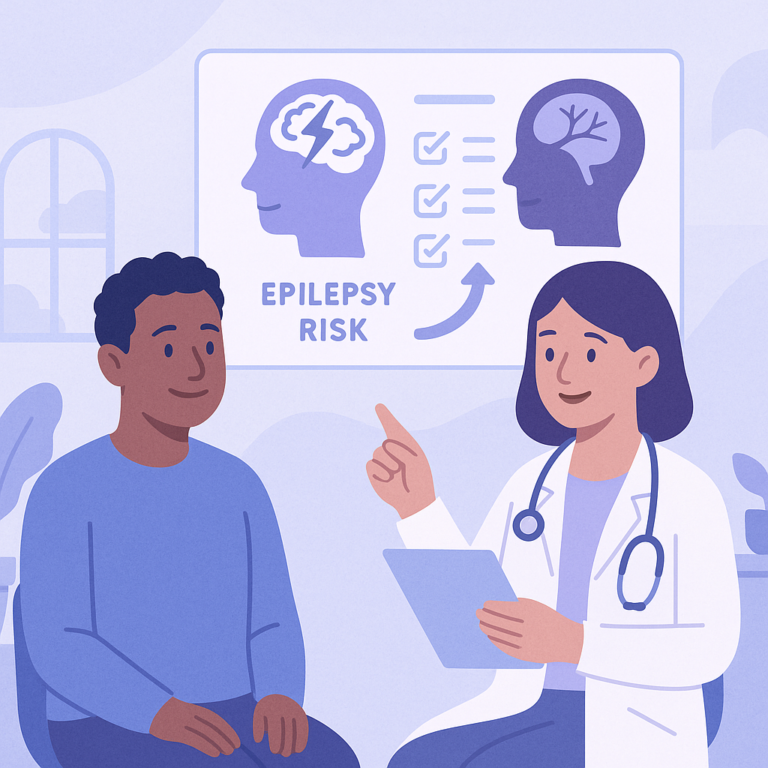
Sudden difficulty speaking or understanding language may resemble a stroke but can also occur with aphasic status epilepticus. This review highlights the need for clinicians to consider this seizure condition during urgent assessment. The authors recommended immediate benzodiazepine treatment when aphasic status epilepticus is suspected, without waiting for EEG or perfusion imaging.
What to watch next
Further studies could examine how diagnostic findings and treatment timing relate to language recovery and longer-term outcomes.
Terms in this summary
- Aphasic status epilepticus
- Ongoing or repeated seizure activity associated with a disturbance of language.
- Stroke mimic
- A condition that produces symptoms resembling a stroke but has a different cause.
- Global aphasia
- Difficulty both producing and understanding language.
- Motor aphasia
- A form of aphasia that mainly affects language production.
- Sensory aphasia
- A form of aphasia that mainly affects language understanding.
- EEG
- A test that records the brain's electrical activity.
- Diffusion and perfusion imaging
- Brain imaging methods that assess water movement and blood flow.
- Benzodiazepine
- A type of medicine used to treat ongoing seizure activity.
Free: Seizure First Aid Quick Guide (PDF)
Plus one plain-language weekly digest of new epilepsy research.
Unsubscribe anytime. No medical advice.