Brain Scans And EEGs May Predict Early Epilepsy Risk
⚠️ Pregnancy-related topic: medication, diet, and testing decisions must be made with your obstetrician and neurology team.
⚠️ Infant dosing/safety: medication and diet decisions for infants require individualized medical guidance.
Source: Developmental medicine and child neurology
Summary
What was studied
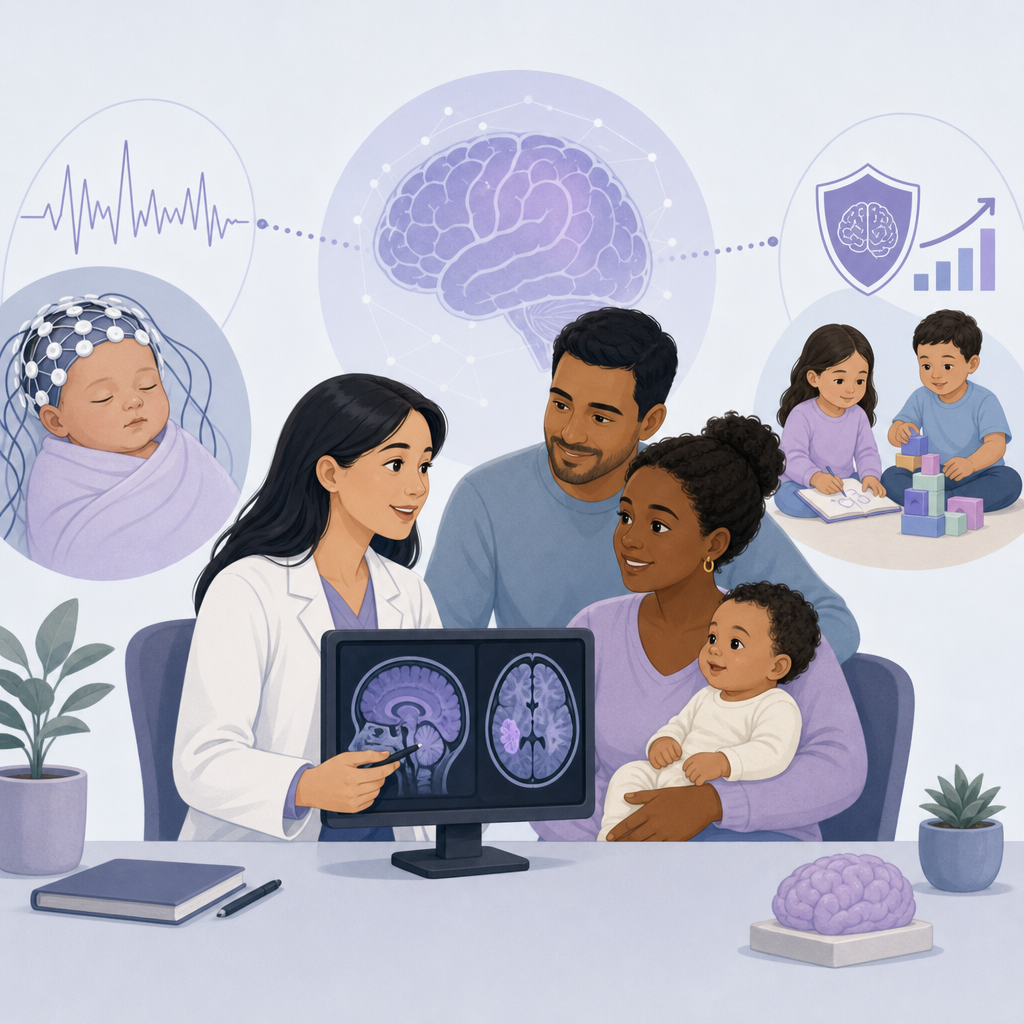
This study looked at whether early brain tests could help identify which babies might later develop epilepsy after a neonatal stroke. A neonatal stroke is a stroke that happens around the time of birth. The researchers reviewed records from 55 consecutive newborns in a population-based cohort. The babies were born between about 34 and 42 weeks of pregnancy and were followed for a median of 80 months.
The study assessed epilepsy outcomes at age 1 year and age 4 years. The researchers examined how those outcomes related to brain MRI, EEG, and somatosensory evoked potentials done in the newborn period, plus EEG findings from infancy. This was a retrospective observational study, meaning the researchers looked back at existing medical records rather than testing a treatment.
What they found
Six children had infantile-onset epilepsy by age 1 year, and three had childhood-onset epilepsy by age 4 years. Compared with children without epilepsy at age 1 year, those with infantile-onset epilepsy more often had infarction of the proximal middle cerebral artery, asymmetry on neonatal EEG, and absent somatosensory evoked potentials on one or both sides. They also had higher total and maximal hourly seizure burden during the neonatal period and recurrent epileptiform activity on their first follow-up EEG.
For childhood-onset epilepsy, the only finding significantly linked in this study was asymmetry on the neonatal EEG, compared with children without epilepsy at 4 years of age. Overall, the results suggest that neonatal neuroimaging and neurophysiology, together with follow-up EEGs, may help identify children at highest risk for infantile-onset epilepsy after neonatal stroke.
Limits of the evidence
This was a small study, especially for the children who developed epilepsy: only 6 had infantile-onset epilepsy and 3 had childhood-onset epilepsy. Because it was observational and retrospective, it cannot show that these test findings cause epilepsy or predict it perfectly. The results may not apply to all babies with neonatal stroke, and the abstract does not give details such as how accurate the tests were for prediction in individual children.
For families and caregivers
For families, this study suggests that early MRI, EEG, and related nerve pathway testing after a neonatal stroke may help doctors recognize which children may need closer follow-up for seizures, especially in the first year of life. It does not mean that a baby with these findings will definitely develop epilepsy, or that a baby without them definitely will not. The main value is in helping guide monitoring and follow-up.
What to watch next
Larger prospective studies could help show how well these tests identify epilepsy risk in individual children after neonatal stroke.
Terms in this summary
- neonatal stroke
- A stroke that happens in a baby around the time of birth.
- epilepsy
- A condition with repeated unprovoked seizures.
- MRI
- A brain scan that uses magnets to make detailed pictures.
- EEG
- A test that records the brain's electrical activity.
- somatosensory evoked potentials
- A test that measures how well sensory signals travel through parts of the nervous system.
- epileptiform activity
- EEG patterns associated with a tendency to have seizures.
- seizure burden
- How much seizure activity a person has over a period of time.
- middle cerebral artery
- A major blood vessel that supplies part of the brain.
Free: Seizure First Aid Quick Guide (PDF)
Plus one plain-language weekly digest of new epilepsy research.
Unsubscribe anytime. No medical advice.