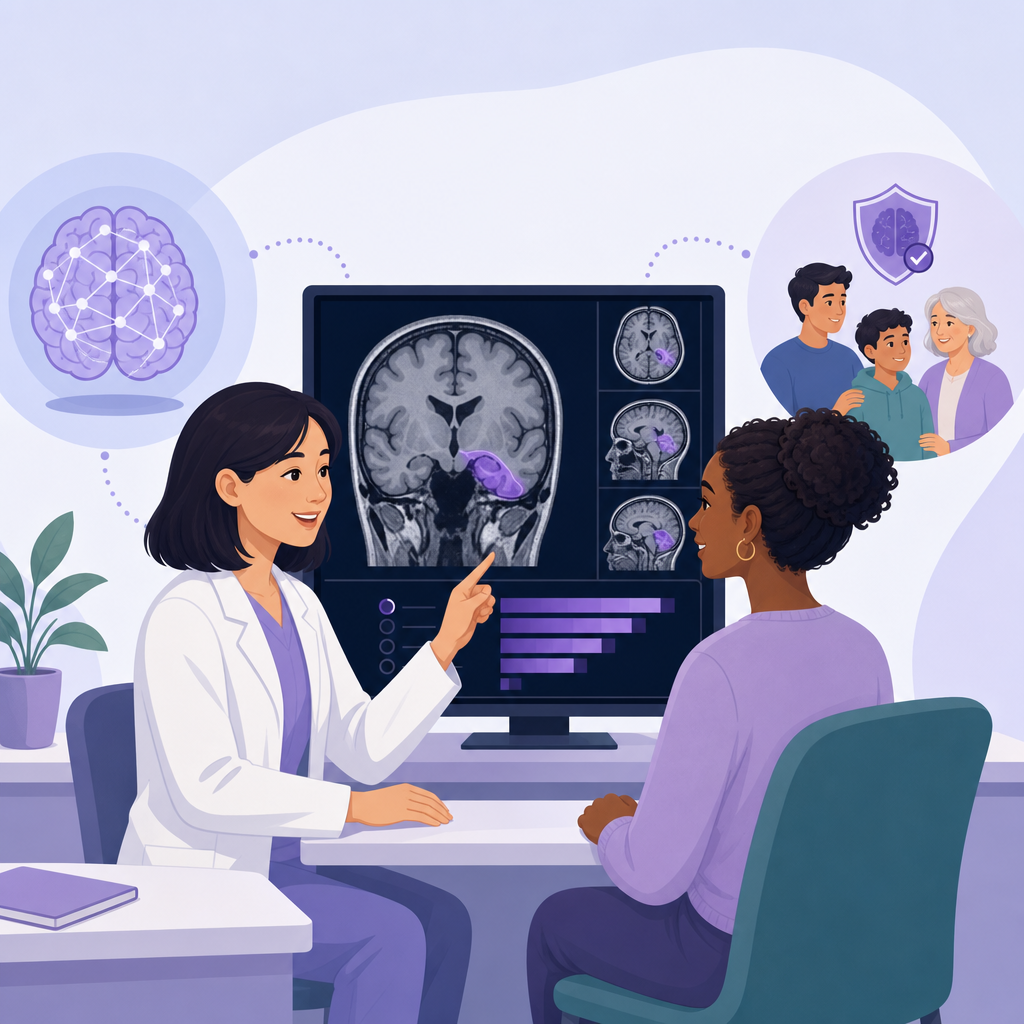
MRI Tool Helps Find Seizure Surgery Targets
Source: Epilepsia
Summary
What was studied
Researchers built and tested a computer program called GATEZ that uses structural MRI scans to rank small brain areas that might be related to the part of the brain removed during epilepsy surgery.
The model was developed using pre-surgery 3D T1-weighted MRI scans from a public surgery database. It was trained and tested in people with a 12-month International League Against Epilepsy class 1 outcome after surgery, using the removed brain area as the reference. The study then evaluated the model in a separate outside group of 183 consecutive surgical patients with epilepsy who had PET/MRI scans, although the model itself used only the MRI images. The researchers also did a blinded study with 3 readers to compare reading MRI alone, MRI plus PET, and MRI plus GATEZ.
What they found
In the internal test group, the model put at least one brain parcel that overlapped the surgery area in its top 10 ranked candidates for 92% of participants. In the outside validation group, this was 87%. The mean positive predictive value for the top 10 candidates was 62% internally and 59% externally, meaning many of the highest-ranked areas overlapped the resection.
In the blinded reader study, adding GATEZ to MRI improved detection compared with MRI alone. Across the 3 readers, detection was 74% to 78% with MRI plus GATEZ versus 58% to 66% with MRI alone. MRI plus GATEZ performed similarly to MRI plus FDG-PET, with detection rates of 78% to 80% for MRI plus PET.
Limits of the evidence
This study does not show that GATEZ identifies the true seizure onset zone. It was trained to match the area removed at surgery, and the removed area may not exactly match the seizure-generating tissue. The main development group included only people with a very good 12-month outcome after surgery, so results may not apply as well to people with less favorable surgical outcomes or to people who are not surgery candidates.
The model used MRI only, but the external validation group came from a center where patients underwent PET/MRI, which may limit how broadly the findings apply. The abstract does not give full details about ages, epilepsy types, or how performance varied across different causes of epilepsy. Reader performance improved in a study setting, but the abstract does not show whether using the tool improves long-term patient outcomes.
For families and caregivers
This study suggests that a computer tool may help doctors take a "second look" at MRI scans when epilepsy-related changes are subtle and easy to miss. It may help create a short list of brain areas to review before surgery planning.
That said, this is not a stand-alone test. Surgery decisions still depend on the full clinical picture, such as seizure history, EEG, MRI review, and sometimes PET or other testing. For families, the main takeaway is that MRI-based AI tools may become a helpful extra aid, but they are not a replacement for expert evaluation.
What to watch next
Useful next steps would include studies showing whether using this tool changes surgical planning and how it performs across many different hospitals and patient groups.
Terms in this summary
- structural MRI
- A brain scan that shows the brain's anatomy and structure.
- presurgical localization
- Finding the brain area most likely involved before epilepsy surgery.
- resection
- Surgical removal of brain tissue.
- FDG-PET
- A scan that shows how the brain uses sugar, which can help highlight abnormal areas.
- validation
- Testing a tool to see how well it works, especially in a separate group of patients.
- positive predictive value
- The share of flagged results that are actually correct.
Free: Seizure First Aid Quick Guide (PDF)
Plus one plain-language weekly digest of new epilepsy research.
Unsubscribe anytime. No medical advice.