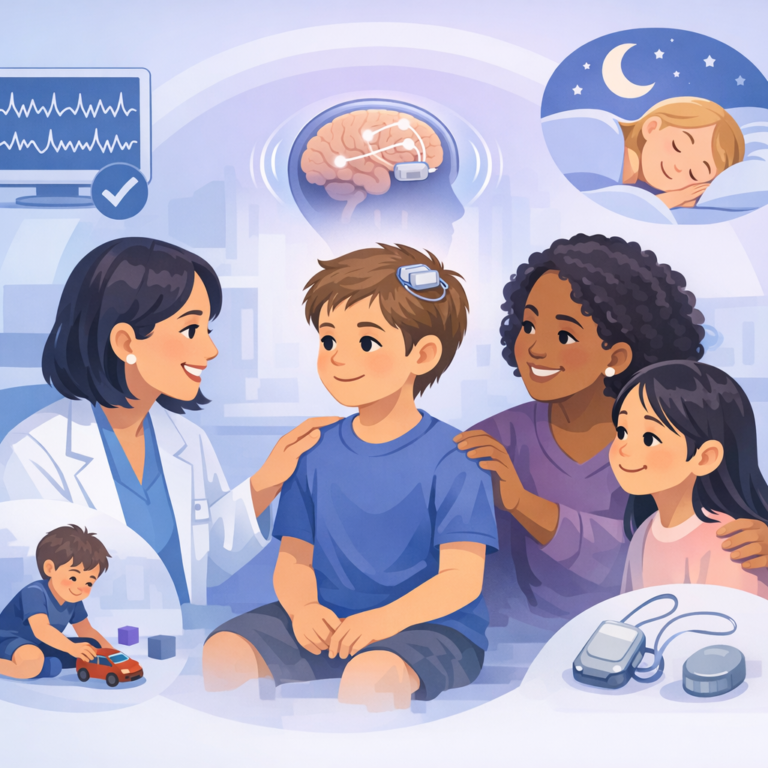
Outside Factors May Shape Development In Genetic Epilepsies
Source: Epilepsia
Summary
What was studied
This study looked at whether outside factors, not just the gene change itself, were linked with development in people with genetic neurodevelopmental disorders (NDDs). Researchers used caregiver-reported data from the Simons Searchlight dataset. They included 970 people across 93 different genetic NDDs; about 67% had epilepsy and 33% did not.
The main outcome was adaptive function, which means everyday skills such as communication, social skills, and daily living. The study also looked at quality of life and autism-related symptoms. Researchers compared people with and without epilepsy and then tested whether factors such as family income, parent education, hospitalizations, and treatment with sodium channel blockers were associated with outcomes.
What they found
People with genetic NDDs who had epilepsy had lower adaptive function than those without epilepsy. In the epilepsy group, higher parent education and higher household income were associated with better quality of life. Some treatment-related factors, especially treatment with sodium channel blocker medicines and more hospitalizations, were associated with lower adaptive function. The authors report that these associations were mediated by epilepsy duration, etiology, and use of multiple seizure medicines, and they suggest these may represent epilepsy-specific effects. Environmental exposures explained more of the variance in developmental outcomes than genetic etiology alone, but a large part of the variance remained unexplained.
Limits of the evidence
This was a cross-sectional study, so it measured factors and outcomes at one point in time. That means it cannot show that any exposure or treatment caused better or worse development. The data were caregiver-reported, which can introduce reporting errors or missing details. The study included many different genetic conditions, so results may not apply the same way to every gene or every child. Also, treatment-related findings may reflect markers of epilepsy severity rather than effects of the medicines themselves. The abstract says prospective, controlled studies are still needed.
For families and caregivers
For families, this study suggests that development in genetic NDDs with epilepsy may be shaped by more than the gene change alone. Factors tied to epilepsy care and family circumstances were linked with outcomes, although the study cannot prove why. The authors note that some external factors may represent markers of epilepsy severity and may help inform early, genetically informed seizure management and careful stewardship of treatment exposures. The results also suggest that the impact of outside factors may differ by genetic diagnosis.
What to watch next
Stronger evidence would come from prospective, controlled studies that follow children over time and help separate effects of the underlying disease from treatment-related factors.
Terms in this summary
- neurodevelopmental disorders (NDDs)
- Conditions that affect brain development and can change learning, behavior, communication, or daily functioning.
- adaptive function
- Everyday skills used for communication, social interaction, and daily living.
- cross-sectional study
- A study that looks at data from one point in time rather than following people over many years.
- multivariable regression
- A statistical method used to test how several factors are linked with an outcome at the same time.
- sodium channel blockers
- A group of antiseizure medicines that work by affecting sodium channels in nerve cells.
- polytherapy
- Using more than one antiseizure medicine at the same time.
- etiology
- The underlying cause of a condition.
- variance explained
- How much of the difference in outcomes a set of factors can account for in a study.
Free: Seizure First Aid Quick Guide (PDF)
Plus one plain-language weekly digest of new epilepsy research.
Unsubscribe anytime. No medical advice.